

The Thunder must find answers for Victor Wembanyama — and it starts with the MVP
I hope we fully appreciate what we witnessed in the Western Conference finals.
A remember-where-you-were Game 1 was the start; a fight-to-the-figurative-death Game 7 was the end. In the middle were five games — decided by double-digits, but defined by absolute haymakers.
By virtue of net rating, the Oklahoma City Thunder and San Antonio Spurs were the two best teams in the NBA. Within the broader context of the league, they were arguably the most important.
On one end, you had the defending champion Thunder, headlined by one of the greatest guards ever, backed by one of the best defenses in league history. On the other were the Spurs, headlined by the most unique superstar in league history with hard-to-quantify dominance, backed by a supporting cast that is equal parts talented and strikingly unafraid of anything or anyone.
The “you do this, we counter with that” of it all permeated this round. The Spurs tweaking how much help to send toward Shai Gilgeous-Alexander; the Thunder shifting who got the Victor Wembanyama assignment. The Thunder stationing their bigs at the wing to move Wemby around the board; the Spurs running every variation of pick-and-rolls with two screeners to stretch the limits of the Thunder’s defense.
This was one of my favorite playoff series of all time. While I’m kinda sad it ended, it does set the stage for what should be a fabulous Finals matchup between the Spurs and the New York Knicks, with the East rep currently sporting [checks notes] the biggest point differential in NBAplayoff history.
Before we get there, it’s worth zooming out with the Thunder.
We start with well-deserved praise. Winning 64 games in today’s NBA is not easy. It’s even more difficult coming off a championship that took seven games to capture; it’s even more difficult to do so while dealing with injuries across the board.
I mentioned this in my MVP piece about SGA, but it’s worth hammering home just how impressive it is that the Thunder had the season they had while 10 rotation players missed at least 10 games. Add in the eventual (re)injuries of Jalen Williams and Ajay Mitchell in the conference finals, and the fact that they pushed this thing to seven — and could’ve conceivably won if they had grabbed defensive rebounds in the second half — speaks to their collective talent and will.
But win, they did not. And now they stare down the barrel of a long offseason that will require some deep, deep soul-searching. That, in my opinion, has to start with the stars.
Can OKC’s Big Three get better?
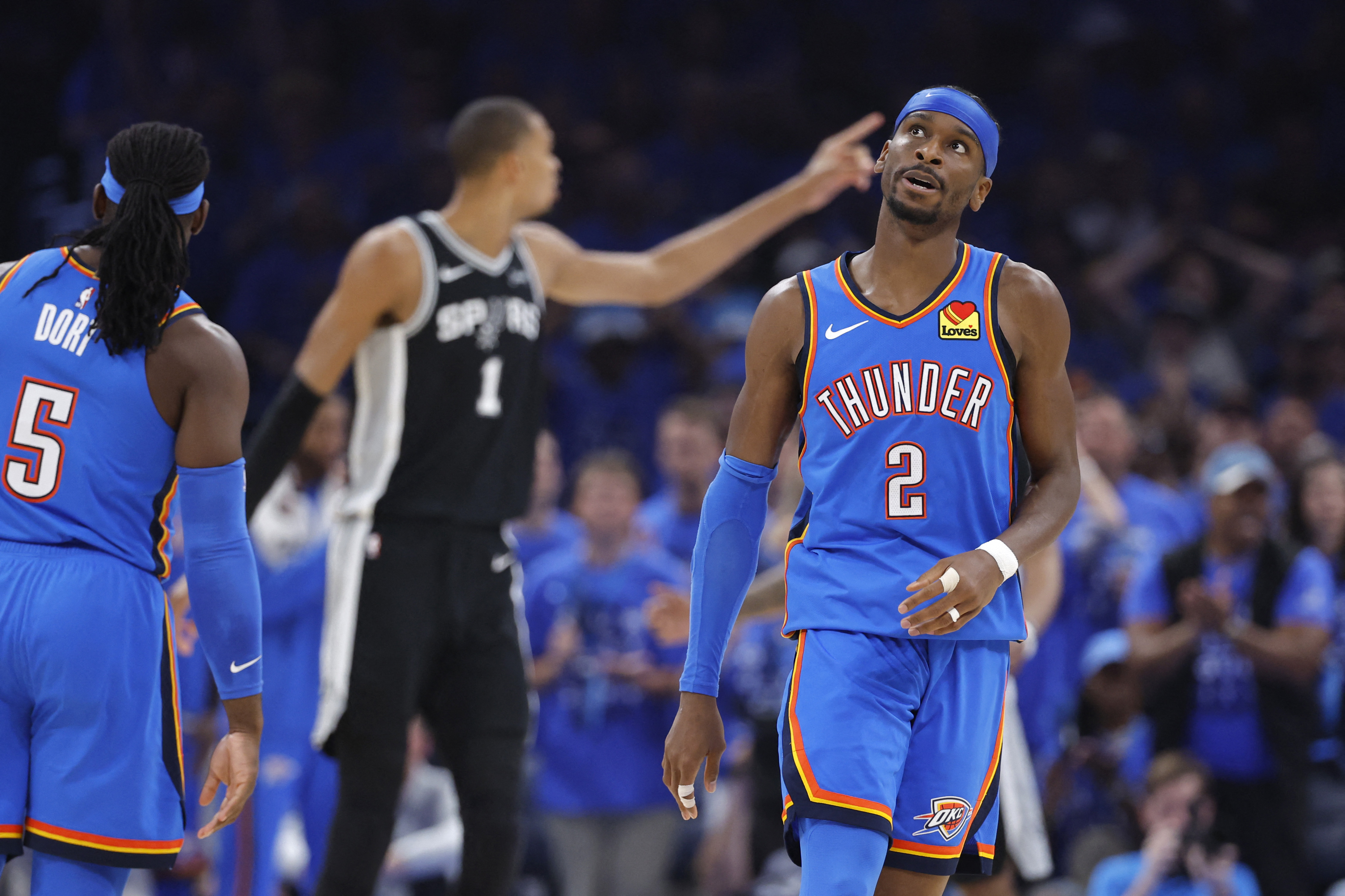
As phenomenal as SGA was this season, the Spurs were able to bother the MVP for prolonged stretches in this series. Wemby is a singular rim-deterring force, but the ball pressure from Stephon Castle, Carter Bryant and others combined with the active (and shape-shifting) help defense goaded SGA into an inconsistent process.
On the high end, SGA was able to punish some of the more aggressive help looks he got with timely kick-outs; he did log 8.9 assists in the series, the highest mark he’s ever logged in a series. The Thunder looked for more ways to get him rolling as a scorer — including screens and seals from Isaiah Hartenstein, mixing in even more wing-clearing cuts to create space, and a slight uptick in off-ball screens as the series went on — with Game 2 (30 & 9) and Game 7 (35 & 9) serving as MVP-level reminders.
On the low end, SGA looked out of sorts trying to create outside of his comfort zone. The growth we saw from him as an off-the-dribble threat from deep during the regular season didn’t carry over. He went 5-of-22 (22.7%) on off-the-dribble 3s in the series, a far cry from his regular-season efficiency (39.1% on 3.4 attempts). With Wemby walling off the rim and the Spurs’ help defenders loading the gaps and disrupting his usual midrange looks, it sometimes felt like there was nothing really there for SGA.
To become more difficult to deal with — and better counter the Spurs’ Wemby-led defense — SGA will have to continue his perimeter growth. The 3-point shooting is a given, though I’d quietly argue there’s room for more volume and fluidity to his off-ball work overall. Assist numbers notwithstanding, there’s still room for growth in terms of processing speed and pass placement.
(It’s generally a stickler take of mine, but rewatching all of SGA’s kicks to the corner in particular highlighted more high or outside-the-pocket passes than you’d like. To be clear, it wasn’t a bad passing series for him, but the margins shrink in the playoffs — especially against a defense like this.)
Williams largely gets a pass since he was injured for so much of his run, but it’s worth keeping an eye on his self-creation in the half-court. It can lean (short) midrange heavy at times; not inherently a bad thing, but it poses the question: how many of these are being taken because he wants them, and how many are being taken because digs from the nail can affect his process?
More than anything, I just want to see a healthy campaign next season.
Then, there’s Holmgren.
Anytime an All-NBA talent underwhelms in a postseason setting, some level of criticism is warranted — just ask Jalen Duren, for example. Holmgren simply didn’t live up to the billing in this series: 10.7 points (58/27/77 splits), 7.1 rebounds and 1.1 blocks just isn’t enough.
Set aside the Holmgren-Wemby rivalry that people were excited about; Devin Vassell comfortably defending him for most of the series is something that should’ve been taken off the table.
That’s on Holmgren for his limitations; the handle and release point on his jumper complicates some of his scoring windows, especially with him playing the 4. Part of the reason he played so much 4 is because, for whatever reason you deem appropriate, the Thunder became increasingly hesitant to let him log time at the 5. We only got 60 minutes with Holmgren on the floor without another big in this series; 59 of them came in the first four games of the series.
Even beyond some of the mechanical issues, there were way too many possessions in this series where Holmgren didn’t even attempt to assert himself. The Game 7 was particularly loud in the wrong way; to play that many minutes and log two shot attempts is frankly beneath a player of Holmgren’s talent level and importance.
There’s also room for criticism toward head coach Mark Daigneault as, by his own admission, he plays a role in putting Holmgren in favorable spots. I generally enjoyed when the Thunder ran Holmgren off of screens to set up some of his touches — either to get him a head start to the rim, or to get him touches near the elbow to isolate.
Perhaps it was the wing-on-Chet gambit and the accompanying physicality that influenced the thinking (though it certainly isn’t new), but it was odd to see those looks virtually disappear. His off-ball screen numbers, per Second Spectrum:
Regular season: 4.9 per game (8.3 per 100)
First round (PHX): 6.8 per game (11.3 per 100)
Second round (LAL): 2.3 per game (3.6 per 100)
Conference finals (SAS): 2.4 per game (4.1 per 100)
That’s just one play-type example, but it does bring a broader “What does maximized Chet look like?” question into play, particularly within the context of future matchups with the Spurs.
Is internal growth from Holmgren alone enough to quell concerns? Is more varied usage enough? Does this just come down to Holmgren bulking up (and staying healthy) enough to log more minutes at the 5, making him a more valuable offensive player almost by default? The Thunder have to find that out; ultimately, whatever the answer is could have a pretty big impact on this upcoming offseason.
OKC’s offseason outlook
To that end, there’s also the obvious financial reality of this group. As laid out by teammate Kevin O’Connor, the Thunder are looking at a hefty payroll with serious second apron implications. The max contracts of Holmgren and Williams will kick in this summer. Cason Wallace (what a baller) will be extension-eligible; considering he’s coming off an All-Defense campaign, it might behoove them to lock in a deal now or “risk” him taking another leap and raising the price next summer. The team options of Hartenstein ($28.5M), Lu Dort ($17.7M) and, to a lesser extent, Kenrich Williams ($7.2M) could force some tough decisions.
Hartenstein, figuratively and literally, is central to their plans. If the Thunder don’t think Holmgren can handle full-time or most-of-the-time minutes at the 5 against the Spurs — or if they can’t find an even bulkier 4 so (Jalen) Williams doesn’t have to guard Wemby or Insert Center Here — Hartenstein becomes a lot less expendable.
His combination of size, physicality, connectivity as a passer and screener, and rebounding is pretty singular for this group. I would anticipate OKC declining his option, but is there a workable, long-term-but-lower-AAV deal to be had to keep him on the roster? The Thunder would have to hope so.
The continued emergence of Wallace could spell trouble for Dort’s future in OKC, though there appears to be a strong mutual love between him and the organization. There’s always the possibility of him taking a team-friendly deal, but I wonder if it’s more likely he cashes out elsewhere to be a culture setter/raiser.
I don’t feel it’s appropriate to seriously explore trades for Holmgren or Williams. It’s a possibility in a literal sense; they could put themselves in the Giannis Antetokounmpo conversation if they really wanted to, I just don’t think they will.
If they want to make a drastic swing, it seems more realistic that they’d aim a tier or two lower. There’s enough pick ammo in the chamber for OKC to make, say, the Pelicans (Trey Murphy III) or Nets (Michael Porter Jr.) pick up the phone if they’re worried about their 3-point volume.
It would be reasonable for the Thunder to ultimately run things back, bank on internal growth and better health, and stay atop the Western Conference. The Spurs winning the matchup this handily, this early, just means they’d better be really sure it’s their optimal pathway.