

2026 NBA Draft grades for all 30 teams: Grizzlies, Thunder get highest marks
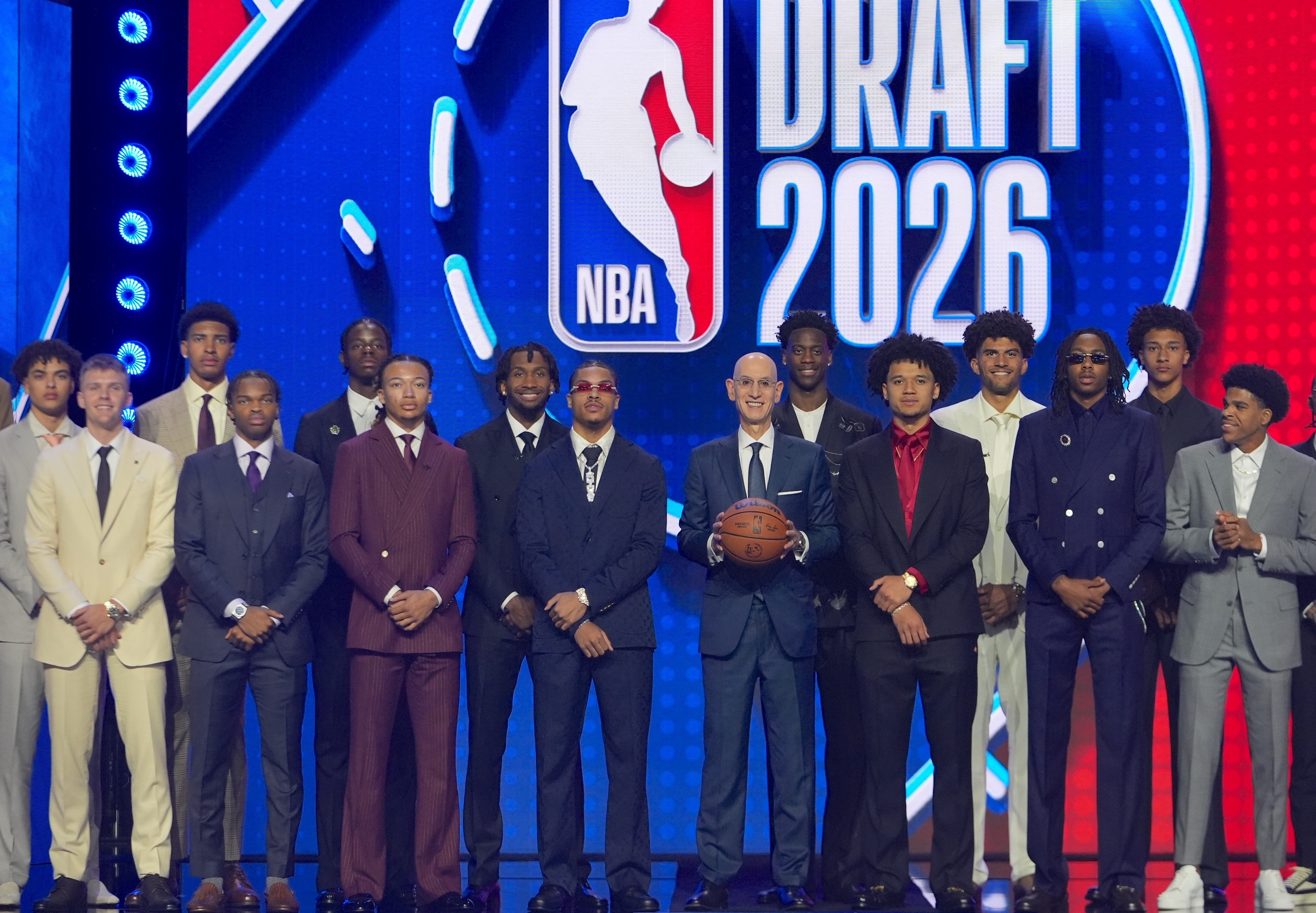
The 2026 NBA Draft is in the books. We graded each pick of the first round and second round. Now let’s get to the overall team grades:
East:Atlanta Hawks • Boston Celtics • Brooklyn Nets • Charlotte Hornets • Chicago Bulls • Cleveland Cavaliers • Detroit Pistons • Indiana Pacers • Miami Heat • Milwaukee Bucks • New York Knicks • Orlando Magic • Philadelphia 76ers • Toronto Raptors • Washington Wizards
West:Dallas Mavericks • Denver Nuggets • Golden State Warriors • Houston Rockets • LA Clippers • Los Angeles Lakers • Memphis Grizzlies • Minnesota Timberwolves • New Orleans Pelicans • Oklahoma City Thunder • Phoenix Suns • Portland Trail Blazers • Sacramento Kings • San Antonio Spurs • Utah Jazz
EASTERN CONFERENCE
Atlanta Hawks
Grade: A-
Round 1: Kingston Flemings (No. 8), Zuby Ejiofor (No. 23)
Round 2: Henri Veesaar (No. 52)
The Hawks re-signed CJ McCollum to a one-year, $21 million contract on Sunday, and found their successor to McCollum in Flemings. Flemings plays with surgical midrange touch, an explosive first step and the passing vision of a true point guard who can run an offense. But Flemings is also 183 pounds and midrange-heavy in a 3-point league, and he watched his efficiency crater against the stiffest competition late in the season. The question is whether his scoring package translates against NBA length and spacing, or whether opposing scouts figure him out the same way late-season defenses did. Still, he brings incredible effort and passion to the floor and will likely maximize whatever he's going to become. Every player on the Hawks' roster can do a little bit of everything. So if there's anywhere that Flemings could best reach his potential, it might be Atlanta.
After selecting Flemings in the lottery, the Hawks bolstered their frontcourt rotation. But Ejiofor is a bit too small. Atlanta needs a taller, beefy center to pair with Onyeka Okongwu. But Zuby brings winning qualities. After his freshman year at Kansas, Bill Self told him he wasn't good enough to play major minutes on any Big 12 team. Three years later, he became the unanimous Big East Player of the Year, Defensive Player of the Year, Tournament MVP, and Scholar-Athlete of the Year — the first player in the league's history to sweep all four in a single season — and he helped St. John's bounce his former team in the Round of 32 on the way to the program's first Sweet 16 in 25 years. Ejiofor found success with foundational skills: motor, length and defensive versatility. The question with Ejiofor is the fact he's undersized for a center and his jumper is still a work in progress. But he's developed enough to deserve a chance to figure it out in the league.
Veesaar falling to the Hawks is quite a shock after most teams had a late first/early second grade on him. But my league sources say Veesaar and his agent Jason Ranne were adamant that he won't sign a two-way contract. The fall, and the Hawks trading up to get him, all point toward Veesaar targeting Atlanta as his destination and a strong possibility that he will sign a full NBA contract. Perhaps it will work out for Veesaar in Atlanta, where he'll fit in as an agile big with real shooting touch, connective playmaking, and baseline big skills with the ability to set screens and catch lobs. He also offers rim protection and is a locked-in help defender. In all three of his collegiate seasons, he made a massive leap in production each year. But he's 227 pounds so his lanky frame can get pushed around, plus he still hasn't fully defined his cornerstone skill.
Boston Celtics
Grade: A
Round 1: Chris Cenac Jr. (No. 27)
Round 2: Dillon Mitchell (No. 40)
As good as Neemias Queta was all year, the Celtics clearly need to upgrade at center after blowing a 3-1 lead to the Sixers in the first round. Maybe Cenac will be the big to do just that. Cenac checks every box on paper as a superb athlete who moves like a wing, has the length to alter shots, and shoots from the perimeter. Houston handed him a starting role with national title aspirations and trusted him with heavy minutes. But the Cougars fell short again, in part because Cenac struggled to stay out of foul trouble, couldn't score efficiently, and was overeager to play on the perimeter despite having the body of a bruiser. He arrived in college with lottery expectations, and he still could become that player in the future. But the Celtics are taking a project.
Mitchell showed up at Texas as a McDonald's All-American, and back then it looked like a jump shot was the only thing standing between him and stardom. Four years and three schools later, the jumper is still nonexistent. Maybe the Celtics can be the team to finally fix it. And yet, he's a top-40 pick in a deep draft class because he's a left-handed power player who finishes everything around the rim, wrecks games on defense, and blossomed into a high-feel passer as a senior at St. John's. The non-shooting is a problem, but Boston is a perfect situation to mitigate it since he can play in lineups where he's surrounded by shooting. Even without the shot, his athleticism on offense and defensive versatility could allow him to carve out a long career.
Brooklyn Nets
Grade: B+
Round 1: Mikel Brown Jr. (No. 6), Joshua Jefferson (No. 28)
Round 2: Tyler Bilodeau (No. 43)
The Nets took four guard-ish players in last year's draft, but Egor Dёmin looks like the only true keeper and that hit didn't stop them from taking an even better guard prospect this year. When Brown is in the zone, he has an unstoppable pull-up jumper, an ambidextrous finishing ability, and the quick reads to rifle passes before the defense has time to react. He had a 45-point breakout performance in February after a back injury dogged him all freshman year and then ended his year later in the month. The absences muddy the evaluation and leave real questions about his consistency that may not get answered until he's fully healthy. Given how different Dёmin's skill set is at 6-8, Brown and Dёmin should perfectly complement each other as Brooklyn builds a foundation for the future.
Jefferson does a lot of the little things very well, but he needs to improve his jumper and his off-the-dribble game. His lack of shooting ability is worrisome for a guy who figures to be a complementary player. At almost 23 years old already, it felt like he'd be a better fit on a contender, rather than a Brooklyn team that's trying to build something up.
Bilodeau was one of the most efficient stretch-4s in college basketball. With his 6-7 frame, he could bring real value with his size and spacing ability at the next level. He made 48% of his catch-and-shoot 3s as a senior, which is precisely what Brooklyn needs to support its young guards. But no one should mistake Bilodeau for Tyler, The Creator, since he rarely takes shots off the dribble or serves as a playmaker for teammates. He also struggles as a defender, which is truly the big question about his ability to make it in the modern NBA.
Charlotte Hornets
Grade: A
Round 1: Hannes Steinbach (No. 14), Christian Anderson (No. 18)
The Hornets were in need of frontcourt reinforcements. Steinbach played professionally in Germany before enrolling at Washington, and he'll enter the NBA with some readymade skills as an interior scorer and rebounder. He has massive hands that he uses to grab every possible rebound and finish effectively around the basket. He also showed legitimate touch on 3-pointers in flashes, which would turn him into a very different player if it becomes real. But he's not quite a true 7-footer, and there are specific matchups where he gets targeted in space. It's encouraging though that he bulked up from 220 to 248 pounds from the start of his freshman year at Washington until now. He was already strong, and now he's making the case that he can be a true center for any team.
The Hornets, who reportedly traded LaMelo Ball to the Timberwolves on Thursday, also added a point guard in Anderson, who showed up at Texas Tech as the 101st-ranked recruit and played his way into the first-round conversation behind dynamic pick-and-roll creation and knockdown perimeter shooting. He does a good job of creating easier shots for his teammates, but at his small stature he hasn't shown a consistent ability to get to the rim with any regularity. And any small guard will always be a target on defense, so there's a lot of pressure on his shot translating to the next level.
Chicago Bulls
Grade: A
Round 1: Caleb Wilson (No. 4), Dailyn Swain (No. 15)
Wilson is the most gifted athlete in the draft class. He's 6-foot-9 with springs for legs. When he's flying above the rim, finishing through contact, and chasing down every shot in his area code, he looks like a future franchise cornerstone. That's exactly what the Bulls need in the frontcourt. After acquiring Nic Claxton from Brooklyn on Monday, the Bulls now have five players in Claxton, Wilson, Matas Buzelis, Josh Giddey, and Noa Essengue, who could in theory switch across positions. The Bulls are massive, athletic, and Wilson can be the centerpiece who becomes one of those defensive anchors while also adding even more upside offensively. For Wilson to reach his peak, though, he'll need to figure out how to shoot jumpers. He has shot well in pre-draft workouts, per sources. Even without the jumper, though, he has star upside. Chicago has to be ecstatic he was on the board here with the fourth choice.
The Bulls also got a potential steal in Swain, who is relentless getting to the rim, creative as a finisher, and active enough defensively to project as a switchable wing. But the reason he lives at the rim is because his jump shot is genuinely terrible. He has stiff mechanics, bad percentages, and a reluctance to even attempt it that goes all the way back to high school. He made improvements at Texas, though, so there's hope his soft touch at the line and from the paint will eventually translate.
Cleveland Cavaliers
Grade: B+
Round 2: Meleek Thomas (No. 34)
Thomas was the top-ranked player on my board in Round 2, but he doesn't exactly solve any problems for the Cavaliers. Donovan Mitchell and James Harden primarily handle the ball, and he doesn't provide size to fill holes for this defense. That said, Thomas is a bucket and this is a "best player available" choice. He's a legit NBA shooter with deep range, a quick release, and creation juice off the bounce. But he doesn't get to the rim, his shot selection drifts into hero-ball, and there are questions about how he'll deal with NBA physicality at 6-3 and 190 pounds — that's why he fell this far despite receiving consideration from teams in the top 20.
Detroit Pistons
Grade: A
Round 1: Ebuka Okorie (No. 17)
Round 2: Ugonna Onyenso (No. 53)
The Pistons need more creation alongside Cade Cunningham, and Okorie is the best driving guard in the class, a 6-1 jitterbug who manipulates defenders with a tight handle, sudden changes of speed, and an advanced feel for the game. He's not an above-the-rim athlete, though, and not long ago he was a kid from New Hampshire who ranked outside the top 100 and committed to Harvard. Then Stanford found him, he flipped his commitment, and he proceeded to lead the ACC in scoring with eight 30-point games and a habit for hitting clutch shots. NBA teams will have to decide whether what carved up the ACC will survive against bigger, longer defenders.
Onyenso could end up an immediate replacement in the frontcourt for Isaiah Stewart, who the Pistons traded to the Grizzlies for three second-round picks on Day 2, opening up cap space to make a big move this summer. Onyenso became one of the most feared shot-blockers in college basketball at Virginia. He had 21 blocks across three ACC tournament games, including nine against Duke and Cam Boozer in the championship. He lays a brick wall around the basket, though he has heavy feet when guarding on the perimeter and is still developing his offensive skill set. Much like Beef Stew, though, he has flashed a jumper. Maybe in Detroit it'll become a fully realized skill.
Indiana Pacers
Grade: A
Round 2: Braden Smith (No. 38)
The Pacers acquired Smith from the Bulls for Kam Jones and swaps, which is quite an interesting decision by Indiana. Tyrese Haliburton will be back next year. Andrew Nembhard handles the ball plenty. And T.J. McConnell remains one of the game's best backup guards. However, McConnell is 34 so adding Smith feels like they're taking a successor for that Sixth Man role. Smith left Purdue as the NCAA's all-time assists leader, breaking a 33-year-old record. He's arguably the highest-IQ player in the draft who could orchestrate an offense at the college level while also providing scoring off the bounce. But the issue is the one every 5-foot-10 guard faces: he isn't a plus athlete, and bigger guards are going to hunt him the moment he steps on an NBA floor. That's precisely why he is a projected second-rounder and will need to work his way up.
Miami Heat
Grade: A
Round 2: Ryan Conwell (No. 37)
Miami badly needs shot creation in the backcourt after dumping nearly everything to acquire Giannis Antetokounmpo from Milwaukee, so it's a logical choice to trade into this spot for Conwell. After his college career took him from South Florida to Indiana State to Xavier, and then to Louisville, he got better at every stop. By the end of his senior year he was the leading scorer for the Cardinals at 18.8 points per game as a knockdown shooter with deep range and a bruiser at the rim who absorbs contact like a fullback. My top comparison for him? Norm Powell, who shined this year with the Heat but is reportedly expected to leave in free agency. Maybe Conwell can fill those shoes as a rookie.
Milwaukee Bucks
Grade: A-
Round 1: Brayden Burries (No. 10), Nate Ament (No. 13)
Round 2: Malique Lewis (No. 60)
Giannis Antetokounmpo is gone, and now the Bucks have two lottery picks to start building the post-Giannis foundation. Enter Burries, who arrived at Arizona as a top-10 recruit, started slow, and then erupted once conference play began, helping lead his team to the Final Four. He's a physical, versatile scorer who can beat you from all three levels, rebounds like a forward, and competes hard on defense. But he's a methodical creator rather than an explosive one, and his shooting history before Arizona gives scouts reason to wonder whether the efficiency is real or a blip.
With Milwaukee's second lottery pick, the Bucks took a big swing with Ament. Players who can handle, shoot off the dribble, and stand at 6-10 don't grow on trees. This physical foundation kept Ament in lottery consideration even after a dreadful start to his freshman season when he struggled to score efficiently and make an impact defensively. But over the second half of the year for Tennessee, he flipped a switch and shots began to fall. He averaged 23.8 points over a six-game stretch in January and February that reminded everyone why he was a top recruit in the country. Then he dealt with an ankle injury that ruined his momentum entering March and he severely struggled during the tournament. Bucks general manager Jon Horst has never been afraid to take risks, though. If Ament pans out, it could look like a stroke of genius.
Lewis, the last pick in the draft, is a switchable 6-8 wing who plays extremely hard and offers connective passing. But he was a horrible shooter until this season when he made 38% of under 100 attempts from 3, plus he has a painfully slow release that is prone to being contested. The Bucks will need to do a lot of work to assure he has more success shooting the ball like he did this past season.
New York Knicks
Grade: B
Round 2: Jack Kayil (No. 39), Tyler Nickel (No. 47)
Kayil just won the German League championship, and now he's joining the NBA champions in New York. Kayil is a combo guard with a strong frame, a feel for the game that exceeds his youth, and the grit to become a high-level defender. He just became one of the youngest players to ever win the German League's Under-22 Player of the Year, joining Franz Wagner and Dennis Schröder on a list that bodes well for his NBA prospects. He committed to Gonzaga back in October, but has decided to stay in the draft — a decision that surprised some scouts since he has yet to prove he can shoot consistently or run an offense full-time. But there's no denying his upside and he could end up one of the late risers in this class.
Nickel has a flamethrower jump shot that Vanderbilt used in a wide array of actions to consistent success all season long. The questions about him are the ones every specialist faces: Does he offer enough other than shooting? Will he survive defensively? But anyone who shoots like Nickel and stands at 6-6 will get a shot to make it in the NBA, which is why New York is making a point out of finding guys who can support the stars.
Orlando Magic
Grade: C
Round 2: Izaiyah Nelson (No. 51)
Nelson is a 6-foot-8 athlete with a 7-foot-3 wingspan who feasts on lobs, rebounds in traffic, and disrupts everywhere on defense. He sets a tone any time he's on the floor. That's all well and good, and precisely why the Magic drafted him. But the reason for the low grade is the fact that Orlando needs to add some shooting, and Nelson is a liability outside of the paint.
Philadelphia 76ers
Grade: B
Round 1: Labaron Philon (No. 22)
While Philon appears to be a good value pick at this point, it's an odd fit for a Philly backcourt that suddenly feels a bit light with him, Tyrese Maxey, and VJ Edgecombe. Philon is a shifty, score-first point guard who blossomed into one of the best guards in college basketball as a sophomore. He doubled his scoring output with buttery floaters, a deceptive handle, and a feel for running an offense, while also beginning to shore up the shooting questions that once clouded his projection. But Philon is also a below-the-rim athlete and is listed under 180 pounds, so his slight frame remains the one thing standing between him and stardom. Is this a team that actually cares about competing today or is this more of a pick for the future?
Toronto Raptors
Grade: A
Round 1: Allen Graves (No. 19)
Round 2: Jaden Bradley (No. 50)
The Raptors clearly needed two things after their Game 7 loss to the Cavaliers: A point guard and a center. Here, they get another wing in Graves, so the front office clearly isn't drafting for need. But with Graves pick, the Raptors are getting a skilled player for his size. Graves was a point guard before a late growth spurt, and the floor skills carried over when he sprouted to 6-foot-8. He came off the bench at Santa Clara as a redshirt freshman and quietly became one of the most efficient producers in college basketball. But he came off the bench, lacks great athleticism, and struggled against the limited top competition that he faced. But the analytics love him, and he passes the eye test with his elite feel for the game.
Bradley is a 6-3 combo guard with a calm demeanor and a knack for clutch moments on offense. After arriving in college as a McDonald's All-American, he lost his starting spot as a freshman at Alabama then transferred to Arizona, where he got better every year and became the team's trusted leader. As a senior, he won Big 12 Player of the Year, Big 12 Tournament MVP, and led the Wildcats to their first Final Four since 2001. There are questions about whether he can be a lead guard at the next level, but his connective passing, improved shooting, and gritty defense all give him the potential to play big minutes.
Washington Wizards
Grade: A
Round 1: AJ Dybantsa (No. 1)
Round 2: Felix Okpara (No. 46)
The Wizards finally land their star. Dybantsa could become one of the NBA's most unstoppable shot-creators. At 6-foot-9, he has a special blend of athletic tools the way he bends, shifts, and explodes with the ball in his hands. Dybantsa led the nation with 25.5 points per game while breaking Danny Ainge's 48-year-old BYU freshman scoring record with a 43-point eruption. He gets to the rim at will, cooks in the midrange, draws fouls at a high rate, and displays point forward potential. After weeks of deliberating between Dybantsa and Kansas guard Darryn Peterson, Dybantsa likely got the nod because he's significantly taller and comes with less baggage.
In Washington, the pressure will be alleviated off AJ early in his career, now that he's teammates with two veterans in an All-Star-caliber big man in Anthony Davis and point guard Trae Young, who agreed to re-sign. The Wizards could even be quite competitive early on in Dybantsa's career, especially if their existing young players get even better: Alex Sarr already looks like an effective two-way big, while guards and wings like Kyshawn George, Tre Johnson, Will Riley, and Bilal Coulibaly have all shown flashes at one time or another. But none of them project to be a superstar like Dybantsa, whose upside will be determined by whether he can become a knockdown 3-point shooter, as well as a more impactful defender to take full advantage of his physical tools. But the native of Brockton, Mass., has a tremendously high floor with his scoring skill alone that gives the Wizards a face of the franchise to build around and the ceiling to be a future MVP.
With Davis and Sarr leading Washington's frontcourt, the Wizards still need some depth behind them. And Okpara knows his role as a player who protects the paint, runs the floor, finishes lobs, sets screens, and doesn't try to be more than that. One thing Okpara, Sarr, and Davis all have in common is their switchability, which could enable Washington to switch screens across positions. The issue is that none of them are reliable perimeter shooters, and Okpara hasn't shown much potential to ever become one.
WESTERN CONFERENCE
Dallas Mavericks
Grade: A-
Round 1: Morez Johnson Jr. (No. 9), Sergio De Larrea (No. 25)
Round 2: Tobi Lawal (No. 48), Vsevolod Ishchenko (No. 56)
Just a day after Dusty May was hired as Mavericks head coach, he gets to continue coaching a player in Johnson who helped May's Michigan team win an NCAA championship a few months ago. New Mavericks president Masai Ujiri has always loved drafting jumbo-sized forwards, which must've been part of the appeal in joining a franchise that's headlined by Cooper Flagg. And that's the logic here with Johnson. You know the guy on a championship team who never gets enough credit nationally? The one who sets the bone-crushing screen that springs the star, then immediately sprints to the rim for the lob, then turns around and blows up the other team's pick-and-roll on the other end all in one sequence? That's Morez Johnson. He transferred from Illinois to Michigan and became the connective tissue of the national champions as a 251-pound wrecking ball with surprisingly soft hands and the defensive IQ to guard 1 through 5 in a switch-heavy scheme. The catch is he's not quite big enough to be a true center and not yet proven enough as a shooter to guarantee he spaces the floor. But even without a jumper, Johnson has a long future ahead of him at the next level.
After drafting Johnson, Dallas traded with the Knicks to get De Larrea. The Spaniard is a tall, playmaking guard with major feel and a knockdown jumper who thrives within team concepts. He suffered a dislocated shoulder that ended his 2024-25 season and removed him from draft boards, but it ended up a blessing in disguise since he returned with a bigger role and stronger production for a great team in the EuroLeague. With size, smarts, and defensive versatility, he could carve out a role with the Mavericks if his international skill can translate.
Lawal feels exactly like a classic Masai Ujiri pick, since he is a London-born forward with size, length, and elite athleticism, but he didn't start playing basketball until age 16 and it shows with his underdeveloped skills. Lawal is a pure project. He's still figuring out his jumper and doesn't do much off the dribble. But with NBA-ready hops and a strong frame, he has the tools to be a highly versatile defender who serves as a role player on offense.
Ishchenko is a fluid wing with an excellent shot off the catch with deep range. The Russian league is a much lower level of competition, which makes it hard to project his NBA future. But he also displayed the handle to operate out of pick-and-rolls. And at 6-foot-8 with a 7-foot wingspan and a wide frame, he has the body to be a quality defender. If the Mavericks nail this pick, the new front office led by Masai Ujiri and Mike Schmitz can flex forever. But Ishchenko is truly just a shot in the dark.
Denver Nuggets
Grade: B-
Round 2: Trevon Brazile (No. 35), Bryce Hopkins (No. 49)
Brazile was a projected first-rounder before tearing his ACL nine games into his sophomore year at Arkansas, and the next two years were spent rebuilding the explosiveness that made him a prospect in the first place. He finally put it together as a fifth-year senior with a career year by anchoring Arkansas' defense. His long wingspan, explosive vertical, switchability, and perimeter jumper will immediately inject much-needed athleticism into Denver's frontcourt. Since Brazile can both defend the perimeter and make 3s — at 35% in his college career — he could play in lineups next to Nikola Jokić. But there's no guarantee that his shot translates, which will be vitally important for his fit on the Nuggets.
Hopkins is a big wing who bullies smaller defenders with hard drives to the rim. But he's not a one-trick pony. He also passes with feel, rebounds, and offers highly versatility defense. Those role player traits could be instantly valuable to the Nuggets, especially since he'll turn 24 as a rookie. Unfortunately, he's still not a reliable shooter, which is the real drawback with this pick after he spent so much time in college due to injuries that extended his stay. But he finally got a full, healthy run at St. John's, regained his explosiveness, and became a pivotal piece on a team that won the Big East title and made a tournament run. And now, he'll try to help Denver get back to contending for championships.
Golden State Warriors
Grade: B-
Round 1: Yaxel Lendeborg (No. 11)
Round 2: Lajae Jones (No. 54)
It's been a brutal year. The Warriors lost Jimmy Butler to a torn ACL and Moses Moody to a torn patellar tendon, watched Steph Curry miss 27 games with knee issues, and finally gave up on Jonathan Kuminga. Golden State has been desperately searching for a young star to extend Curry's championship window, and bridge into whatever comes next. It will be harder to do that here after not getting lucky in the lottery. But maybe the Warriors will find a star: Lendeborg has a compelling story. Poor grades kept him off his high school varsity team. He went to a JUCO. Then UAB. Then he entered the draft, went through the combine, pulled his name back, and came back for one more year at Michigan and won a national championship. He just kept getting better every single time the competition got harder. He fills the stat sheet, he can play multiple positions, and he has a 7-foot-4 wingspan at 240 pounds with a genuine handle. He'll be 24 as a rookie, but that aspect could be appealing to Steve Kerr, who re-signed for a two-year deal. Yaxel comes in ready. Whether his story ends with NBA stardom is still up for debate.
Jones is a switchable wing with an NBA-ready body, connective passing skill, and a mechanically sound shooting stroke. Those traits all make perfect sense for Golden State's system. But shots haven't fallen with any regularity yet despite his soft touch from the line, and the Warriors are still in need of more shooters.
Houston Rockets
Grade: A
Round 2: Bruce Thornton (No. 31)
The Rockets traded up to acquire Thornton from the Knicks, giving them a third small guard alongside Fred VanVleet and Reed Sheppard. Could this make Sheppard, the third pick in 2024, more expendable? Perhaps so, because Thornton is a three-level scorer with playmaking feel and the competitive fire that lifts a locker room. And even though he's short, he weighs 223 pounds and has a 6-foot-5 wingspan. Players with his intangibles can prove to be important to winning teams though. He was a four-year captain at Ohio State, and improved every year on his way to becoming the school's all-time leading scorer.
LA Clippers
Grade: B
Round 1: Keaton Wagler (No. 5)
Round 2: Baba Miller (No. 36), Nick Martinelli (No. 55), Narcisse Ngoy (No. 57)
After weeks of rumblings that the Clippers would trade down, they stayed put and took a guard of the future in Wagler, who stands at 6-5 and can play with or without the ball and proved that last year in college. With only two seasons remaining on Darius Garland's contract, he should not be a factor in their choice here. But Wagler's height does give him a better chance to play alongside Garland.
At Illinois, Wagler quickly became the orchestrator of a high-powered Illinois offense with his high-IQ playmaking and crafty scoring. Then he scored 46 at Purdue against a top-ranked team in the country — the most points by any freshman in Big Ten history. Then he kept rolling, and led the team to an unexpected Final Four appearance. Next to Garland, there'd be less pressure on him to be the man right away, which could be beneficial for his development. To become an NBA star, Wagler needs to overcome a lack of traditional athleticism after logging zero dunks as a freshman. But the best case is that his feel for the game is enough for him to continue ascending.
The Clippers are also building quite the athletic frontcourt after taking Yanic Konan Niederhauser last year, and now Miller, who retains the fluidity that he had growing up playing guard before a late growth spurt. Miller has perimeter skill with the way he can handle in the open floor, make advanced moves, and switch across positions on defense. The big issue, and the main reason why he has spent four years in college, is that he still can't shoot. Unless the Clippers have a fix for that problem, spacing could be tight for the offense.
Martinelli is a 6-7 lefty who hunts mismatches in the post, uses footwork and physicality to compensate for his average athletic profile, and he plays with a fire in his belly. He arrived at Northwestern as a three-star recruit, got notably better in each season, and proceeded to become the back-to-back Big Ten scoring champion. There are no questions about his work ethic. The real concern is about whether he can adapt at the next level when he can't feast on smaller players, and when he'll be targeted on defense. But he's beaten the odds so far and will receive chances to prove he belongs with the Clippers.
Ngoy committed to Auburn after playing professionally in France as a massive 7-footer with a 7-foot-7 wingspan. He's incredibly raw and offers nothing on offense other than highlight-reel-worthy dunks, but he has the size and the athleticism to someday become a high-level rim protector and rebounder.
Los Angeles Lakers
Grade: A-
Round 1: Cameron Carr (No. 24)
Luka Dončić said in a recent interview that he'd ideally like to be paired with shooters that can space the floor so he's not doubled as often. Well, he got his wish here with Carr after the Lakers traded up to the No. 24 pick with the Knicks. You could have watched every Tennessee game for two years and genuinely not known that Carr existed. Then he transferred to Baylor, and led the team in scoring, shot nearly 40% from 3 on high volume, and looked like a 3-and-D role player who also has blossoming skills off the dribble. With NBA genes in his blood, as the son of former player Chris Carr, Cameron has the skills to make it in the NBA. But at 184 pounds with not a ton of games under his belt, he's going to get introduced to the NBA's physicality in a way college basketball never did. The Lakers could use his shooting and creation, though, as another wing on the roster.
Memphis Grizzlies
Grade: A+
Round 1: Cameron Boozer (No. 3), Karim López (No. 21)
Round 2: Richie Saunders (No. 32)
This choice was an easy one for the Grizzlies: Just take the best remaining of the top three prospects, and go home happy. And Grizzlies fans should be after landing the most polished player in the class. At 6-foot-8 and 253 pounds, Boozer scores from the post with both footwork and power, hits 40% of his 3s on high volume, and has enough handle to run offense as a point forward. He shifts between those modes based on what the defense gives him, and that adaptability led to a 35-win season at Duke and the Naismith Player of the Year. The worry is that he's not a vertical athlete and the foundation of all that production — overpowering smaller defenders — gets diminished against NBA length. Plus, he's a modern tweener on defense, lacking the explosiveness and size to protect the rim full-time and the lateral quickness to switch onto guards.
But Boozer is at his best defensively when paired with a true center, and he's got one by his side in Zach Edey. With Cedric Coward, Jaylen Wells, and the other young guys in Memphis — plus whatever pieces get dealt for Ja Morant, who league sources say remains likely to get traded — the Grizzlies now have one of the league's best young cores. With the bloodline of two-time All-Star Carlos Boozer, the Grizzlies are betting that skill, adaptability, and a track record of winning at every level all lead to superstardom.
The Grizzlies also got a potential steal in López, who is the best basketball prospect Mexico has ever produced. He left Hermosillo at 14 to play professionally in Barcelona, then at 17 moved to Auckland, New Zealand, where he shined for two years in the NBL Next Stars program. He checks a lot of boxes with his excellent physical tools, a hard-nosed approach, a well-rounded ability to defend multiple positions and handle the ball, and a blossoming shot. But he's thus far more of a jack of all trades since his jumper runs hot and cold and he lacks the burst to blow by defenders off the bounce. Regardless, not every player is drafted with stardom in mind. López has all the requisite skills to enhance a star teammate as a key piece on a winning team.
Saunders might turn 25 years old as a rookie, but he's a hard-nosed, two-way wing who plays with manic energy, hustling around the floor hunting for steals on defense and jumpers on offense. When he appeared on my podcast, he discussed his recovery from a torn ACL that ended his career at BYU and said when he returns to the court he's most looking forward to using a swim move on an opponent to crash the offensive glass — that's exactly the hustle the Grizzlies know they're gonna get from him. He's also skilled, though, with a quick-trigger jumper, soft touch on floaters, and a feel for moving the ball.
Minnesota Timberwolves
Grade: B
Round 2: Isaiah Evans (No. 33), Trey Kaufman-Renn (No. 59)
With Donte DiVincenzo sidelined due to a torn Achilles, it makes perfect sense for Minnesota to take Evans. He's a legitimate sharpshooter with the off-ball chops to thrive without even running any offense for himself, which is the key playing next to Anthony Edwards. Evans is the kind of shooter that defenses guard and think they've got him contained, then he uses a screen and catches it off a full sprint, moving away from the rim, and he somehow manages to rise into a perfect 3-pointer. But after serving as a shooting specialist as a freshman, he showed off a developing handle as a sophomore which could eventually unlock more creation chances.
Kaufman-Renn is a throwback post hub who bullies smalls, finesses bigs, and passes like a point center. If the Timberwolves are indeed looking to trade Rudy Gobert, then Joan Beringer could be thrust into a starting role and Kaufman-Renn could be forced to play minutes off the bench. But he's a ground-bound tweener who can't shoot and barely blocks shots — he logged only 39 in 147 career college games. He'll have a steep hill to climb to earn the trust of Wolves head coach Chris Finch.
New Orleans Pelicans
Grade: C
Round 2: Jaron Pierre Jr. (No. 58)
The Pelicans made attempts to trade into the first round, and failed to do so, which affects their grade. As for their late second-round choice: Pierre is an athletic wing who scores from all three levels, hits 40% of his catch-and-shoot 3s, and tends to make the right decisions off the dribble. But he needs to put greater effort into his defense to earn minutes in New Orleans for reasons other than his scoring.
Oklahoma City Thunder
Grade: A+
Round 1: Aday Mara (No. 12), Bennett Stirtz (No. 16)
Round 2: Otega Oweh (No. 41)
The entire NBA breathed a sigh of relief when the Thunder didn't move up in the lottery. But then, the player they were targeting ended up falling to them at No. 12 anyway. With this pick, courtesy of the Clippers for Paul George, they add a potentially vital piece for future battles against Victor Wembanyama in Aday Mara. Mara stepped on UCLA's campus as a lottery-projected center from Spain. Then he fell off draft boards during two forgettable seasons there before transferring to Michigan and becoming one of the best true 5s in the country on his way to winning the national championship. He reads the floor like a guard, finishes with both hands, and swats shots with elite timing. The complication is he doesn't shoot from outside, makes below 60% of his free throws, and opponents are going to attack him on the perimeter. The Thunder seemingly have a way of turning shaky shooters into reliable shooters though. If Mara figures out how to shoot, it'll be a nightmare for the NBA. Even if he doesn't, well, the Thunder are already a nightmare.
Four picks later, the Thunder moved up to acquire Stirtz from the Grizzlies, which signals that Sam Presti sees a need to add even more shot-creation depth after they ran out of it in the West finals against San Antonio. Stirtz feels the game at a different frequency than everyone else on the floor, and yet still makes scouts squint because he doesn't look the part athletically. The question isn't whether he can play, though. After transferring from Drake to Iowa, he kept cooking with bull's-eye passes, pump-fakes and shooting touch off the dribble from NBA range. If he adjusts to the physicality and speed of the NBA, he could thrive as both a floor general and off-ball connector.
Oweh made 38% of his catch-and-shoot 3s over his four-year college career. By simply eliminating shots off the dribble, as the Thunder will likely force him to do, he could become a 3-and-D player as a 6-4 wing with a strong frame, versatile defense, and connective passing skills. But there's a chance he taps into a higher level of upside, given his ability to catch fire as a scorer: He had one of the great games of the season with 35/8/7 against Santa Clara in the opening round of March Madness with a buzzer-beater to force overtime. The odds are he'll need to adapt as a role player, and that alone would be a win for Oklahoma City.
Phoenix Suns
Grade: B-
Round 1: Koa Peat (No. 30)
The Suns traded into the first round to select Peat, who played both high school and college ball in Arizona. Peat's bloodline is so loaded with offensive linemen that it's almost funny he ended up playing basketball. His father played nine NFL seasons. His uncle was a Pro Bowl tackle. Two brothers played college ball on the line. And you can absolutely see it in how he plays: powerful, physical, relentless, and it genuinely takes something special to stop him from getting to where he wants to go. He opened the season with a 30-point game against defending champion Florida and backed it up as one of Arizona's best players all year on its way to the Final Four. But since Peat can't shoot yet, it'll be important that he's paired with a floor-spacing center. Or he could serve as a small-ball center in switchable lineups.
Portland Trail Blazers
Grade: Inc.
Round 1: None
Round 2: None
Sacramento Kings
Grade: A
Round 1: Darius Acuff (No. 7), Alex Karaban (No. 29)
Round 2: Emanuel Sharp (No. 45)
Credit to the Kings front office for correctly calling the bluff by the Clippers and Nets, both of whom were rumored to threaten taking Acuff to force the Kings to move up in the draft. But Sacramento stuck with this spot and was rewarded with the guard the front office wanted all along in Acuff, a wiry scorer who can get a bucket from anywhere on the floor with a quick trigger, slippery handle, and a feel for manipulating defenses. After entering college with the reputation of a ball hog, he changed that and emerged as a skilled, low-turnover playmaker who sprayed the ball around the floor and put in significant effort moving off-ball. So while he is not the biggest guard or the most explosive athlete, he reads defenses like someone who's been in the league for a decade. He still needs to make dramatic improvements on defense, though, as he was one of the worst defenders in college basketball last season. Kings general manager Scott Perry and assistant general manager B.J. Armstrong were both born and raised in Detroit. So is Acuff. Perry coached Acuff's father at Eastern Kentucky in the late 1990s. So there is a lot connecting Acuff to this organization, and here he'll get a chance to become the savior of the franchise.
The Kings aren't winning games right now, but with Acuff and an aggressive trade into the first round for Karaban, they have two guys who can help set the franchise on that path again. Karaban makes defenses pay the moment they relax on him. He relocates for a 3, cuts when nobody's watching, and does everything efficiently. He's a similarly high-effort, high-IQ player on the defensive end, which helps him overcome his average athleticism. But he'll be 24 as a rookie, and hasn't shown much upside. He rarely shoots off the dribble because of his funky mechanics. So if his role-player skills are slow to translate, his margin for error is narrower than for most.
Sharp's calling card is his shooting ability. He can catch fire from 3-point range and be utilized as a weapon off screens. He plays with a high IQ even though he isn't a primary shot creator as well. On defense, he plays extremely hard to help compensate for the fact he's on the smaller side at only 6-3. Sharp should serve as a great spark off the bench behind Acuff for Sacramento.
San Antonio Spurs
Grade: B-
Round 1: Jayden Quaintance (No. 20), Tarris Reed (No. 26)
Round 2: Ja'Kobi Gillespie (No. 42), Maliq Brown (No. 44)
If there's any team that's going to take a big, big swing, it's San Antonio. Remember when Victor Wembanyama was drafted and there were rumblings the Spurs had interest in Brook Lopez? Quaintance isn't exactly the same type of big man, but picking him here does suggest the Spurs have a vision for playing more two-big lineups, whether Quaintance is sharing the floor with Wemby or coming off the bench alongside Luke Kornet. As a freshman at Arizona State, he was blocking everything in sight, showing defensive instincts and mobility that players his size aren't supposed to have, and he was 17 years old doing it. Then came the ACL, the meniscus, the fractured knee, the transfer to Kentucky, persistent swelling, a shutdown for the remainder of his sophomore season, and an inability to fully work out for teams during the predraft phase. At some point, someone was gonna take a swing on him, though, and it's hard to fault the Spurs for swinging for the fences here.
The Spurs moved up from the No. 35 pick with a trade with Denver and went big again by selecting Reed. With Wembanyama looking fatigued in the NBA Finals, maybe the Spurs saw reason to bolster the frontcourt rotation to alleviate the load off him. We could also see far more two-big lineups in the future so Wemby doesn't need to handle every bruising battle in the paint. Reed is a throwback center who played at his best on the biggest stage on UConn's way to the national title game. He does all the dirty work inside the paint as a finisher, rebounder and shot-blocker. But beyond his ability to screen and pass, he isn't all too comfortable on the perimeter as a shooter or defender. So there are questions about his upside, especially since he'll be 23 as a rookie.
Gillespie offers a totally different style to the San Antonio backcourt as a spark plug who comes off the bench, fires jumpers and reliably runs the offense. The NBA's track record with guards his size is the obvious concern, but anyone who shoots like Gillespie and processes the game at his level deserves a real chance. And if there's any team that can compensate for a small guard, it's the Spurs simply by having Wembanyama on the floor.
San Antonio added more size in the frontcourt with Brown, who guards all five positions and has both the length and IQ to anchor the defense when he's on the floor. As a 6-foot-8 senior, he was named ACC Sixth Man of the Year and won the Lefty Driesell Award as the nation's top defender. With Quaintance likely to redshirt his entire rookie season due to an upcoming knee surgery, Brown could help fill that versatility role early in his career. But he's not a guarantee to make it since he struggles to shoot the ball, making him a hard offensive fit.
Utah Jazz
Grade: A
Round 1: Darryn Peterson (No. 2)
As much as Jazz owner and BYU alum/donor Ryan Smith might have wanted to keep Dybantsa in Utah, it could end up for the best to land Peterson, who is a buttery smooth scorer with a blend of fluid body control and positional size that gives him the ingredients to become an elite NBA player. At the high school level, he was a dynamic playmaker who used his burst to get into the teeth of defenses and generate buckets for himself and his teammates, while also showing off the kind of shot-making that draws comparisons to Hall of Famers. At Kansas, he thrived in an off-ball role, stroking jumpers out of movement actions and showing he can scale up or down depending on what a roster needs.
Peterson will join a talented young group featuring Ace Bailey, Cody Williams, Brice Sensabaugh, and Keyonte George, so his ability to shine with and without the ball will be highly valuable. The concern isn't his game. It's his body. He missed 11 of 35 games and pulled himself out of others due to cramping, which he claims are due to taking creatine. But it's hard to imagine a better situation for Peterson. Even when he isn't scoring, he's a high-impact defender who causes chaos off-ball and has the 6-foot-11 wingspan to switch screens. Now he'll have support around him with All-Stars Lauri Markkanen and Jaren Jackson Jr. in the frontcourt, and the aforementioned blossoming young talents. The Jazz are actually pretty stacked on paper, especially if Walker Kessler re-signs and stays healthy next year. All this talent means that Peterson won't have to play savior, and, like Bailey last year, can ease into his NBA routine as a rookie.