

LaMelo Ball raises more questions than he answers in Minnesota
In a surprisingly fast-moving development, the up-and-coming Charlotte Hornets pivoted from building off the momentum they had made at the end of last season, when they were one of the NBA's hottest teams, to trading a 24-year-old face of the franchise.
Charlotte dealt one-time All-Star point guard LaMelo Ball to the Minnesota Timberwolves in exchange for Naz Reid, a 2033 unprotected first-round draft pick, first-round pick swaps from 2028-30 and second-round picks in 2029, 2032 and 2033, per ESPN's Shams Charania. What will be a four-team trade will also send Julius Randle to the Brooklyn Nets. (Chicago is the fourth team involved.)
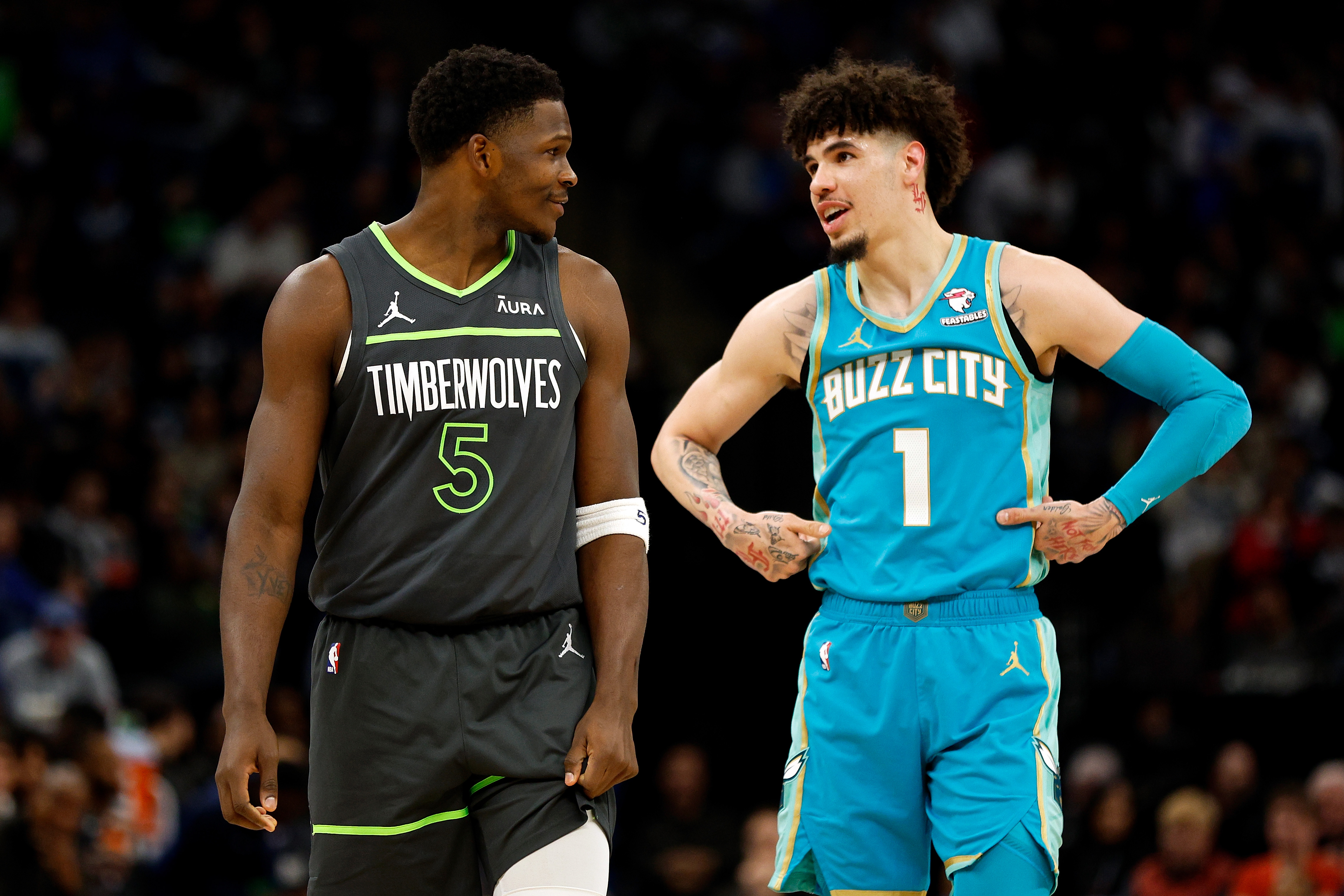
The move pairs the Nos. 1 and 3 picks from the 2020 NBA draft in Minnesota's backcourt, as Ball will join four-time All-Star shooting guard Anthony Edwards on a team that hopes to vie for a championship. The Wolves made the 2024 and 2025 Western Conference finals, before losing a six-game, second-round series to the San Antonio Spurs this year.
There was a widening gap between the Spurs and the 2025 NBA champion Oklahoma City Thunder and everyone else in the West, and Minnesota executive Tim Connelly was desperate to close it, adding one of the most mercurial players in the league to his mix.
Handing the keys from 38-year-old veteran point guard Mike Conley Jr. to Ball is akin to switching from a reliable and safe Volvo, even if it has 200,000 miles on it, to a barely street-legal motorbike. You may get where you are going faster, but the risk is manyfold.
Ball is such a carefree player, he often gets careless, and for the most part that has not been a winning formula in Charlotte, where the Hornets did not make the playoffs in his six seasons on the team. That's right: The Timberwolves just tied their playoff hopes — the hopes of their 24-year-old superstar — to another who has never been in the setting.
Yes, the Hornets were 9.9 points per 100 meaningful possessions better when Ball was on the court last year, scoring at a rate (123.2 points per 100 possessions) commensurate with the greatest offenses ever. And, yes, he gives the Wolves a second elite shot creator.
But … (and there is always a but with Melo) just because he creates shots does not mean he makes them. Ball has shot well below 50% on 2-pointers in his career, and he is an average 3-point shooter who takes a ton (10.3 per game last season). Among the league's 20-point scorers last season, only Dillon Brooks had a worse true-shooting percentage.
Likewise, Ball is an electrifying passer, but his passes do not always find their intended target. He owns the same turnover percentage (13.2%) as Randle on much more usage.
Then, there is the matter of defense, where Ball is a liability. The Wolves will bank on the presence of four-time Defensive Player of the Year Rudy Gobert, plus Edwards and Jaden McDaniels — a pair of wolverine-like wings — to mask Ball's deficiencies on that end, and they may be right to do so. They constructed a top-10 defense around Randle last season.
But how many deficiencies do the Wolves want to mask when they are on the hook to pay Ball $46.4 million in the 2028-29 season? We haven't even broached his injury issues.
Mostly dealing with ankle injuries, Ball missed more than half of Charlotte's games from the 2022-23 season through the 2024-25 campaign, including season-ending surgeries to his right ankle in 2023 and 2025. He played 72 games last season. Only once has he played more, and that was his sophomore season, when he made his only All-Star team.
And that seems to be what Connelly is banking on, this stretch this season, when for a few months Ball amplified the Hornets into one of the league's most formidable teams.
Even then he steered them into a 31-point blowout loss to the Orlando Magic in a play-in tournament game for the No. 8 seed. In three career play-in tournament games, Ball has averaged 26.3 points (on 36/24/90 shooting splits) and 7.7 assists (against 3.0 turnovers), looking very much like the high-usage, low-efficiency brand of player he has mostly been.
How that meshes with Edwards, one of the league's most talented players, who has turned himself into a highly efficient player, is anybody's guess. Rookie Kon Knueppel thrived alongside Ball in Charlotte this past season, but Edwards is no Knueppel. He will not defer to Ball. He will expect Ball to defer to him, and who knows how that will go?
Who knows how any of this will go? The Wolves just replaced one of the league's most unpredictable players in Randle with an even more unpredictable one in Ball, hoping, it seems, that his randomness randomly produces a title via the gauntlet that is the West. That is a fine needle to thread. Ball raises more questions than he answers in Minnesota.