

On Lou Gehrig Day, as always, Sarah Langs is working
Over the past few years, nobody on Earth has watched more Major League Baseball than Sarah Langs.
She disputes this notion, humbly insisting that somebody, somewhere, has her beat. But as the sport’s preeminent baseball researcher knows well: You can’t argue against facts.
Langs estimates that she has seen about 99 percent of all live MLB action so far this regular season. On a day when she heads to the yard — usually either Yankee Stadium or Citi Field — the 33-year-old fun-fact machine might miss a handful of innings while in transit. Occasionally, she’ll get a late start after burning the midnight oil and not see the very beginning of a noon ET first pitch.
She is human, after all.
But far more often than not, Langs is working. Watching, thinking, searching, hypothesizing, producing, contributing.
Her actual job title — Senior Manager, Research and Content at MLB.com — undersells the scope of her influence. Langs is an indispensable resource for nearly every writer, reporter and creator at the league-run outlet, providing a seemingly never-ending stream of stats to be incorporated into their stories, videos and tweets. Her Slack is a sight to behold. One second, Langs is contacting the Elias Sports Bureau about something that hasn’t happened since the fall of the Ottoman Empire. The next, she’s crafting another one-of-a-kind nugget about Shohei Ohtani.
Very, very little gets by her keen gaze and lightning-quick mind. Her brain whirs like a supercomputer — calculating, pondering, sharing and on to the next. Over time, Langs has developed a preternatural, real-time sense for what matters and what doesn’t within the baseball landscape. That allows her to turn observation into insight in a matter of seconds.
I recently asked her how she does it, how she fostered this deep understanding of the rare, the singular, the unique. In her eyes, it all starts with genuine curiosity.
“Definitely a combination of innate and learning by doing and paying attention,” she explained. “This job I have is an extension of the questions asked over dinner and while watching games throughout my childhood in my family. I’m just answering them now.”
It certainly helps that Langs, aided by the magic of modern technology, can quite literally watch every game at once. And so, from her desk, she sees it all, eyes darting ferociously among screens like a stocktrader on their 10th cup of coffee. When something catches her attention, she strikes like a jungle cat, pivoting instantaneously to the cornucopia of research tools at her disposal. The best stuff, always tinged with genuine positivity, ends up on her Twitter feed for the baseball world to enjoy.
That Langs singlehandedly produces so much compelling, informative content is all the more remarkable considering the difficult circumstances of her day-to-day life. In 2021, Sarah was diagnosed with Amyotrophic lateral sclerosis, or ALS, also known as Lou Gehrig’s disease. The neurodegenerative condition affects motor neurons, nerve cells in the brain and spine that handle muscle control, movement and breathing. ALS is progressive, meaning the symptoms get worse over time. There is no known cure.
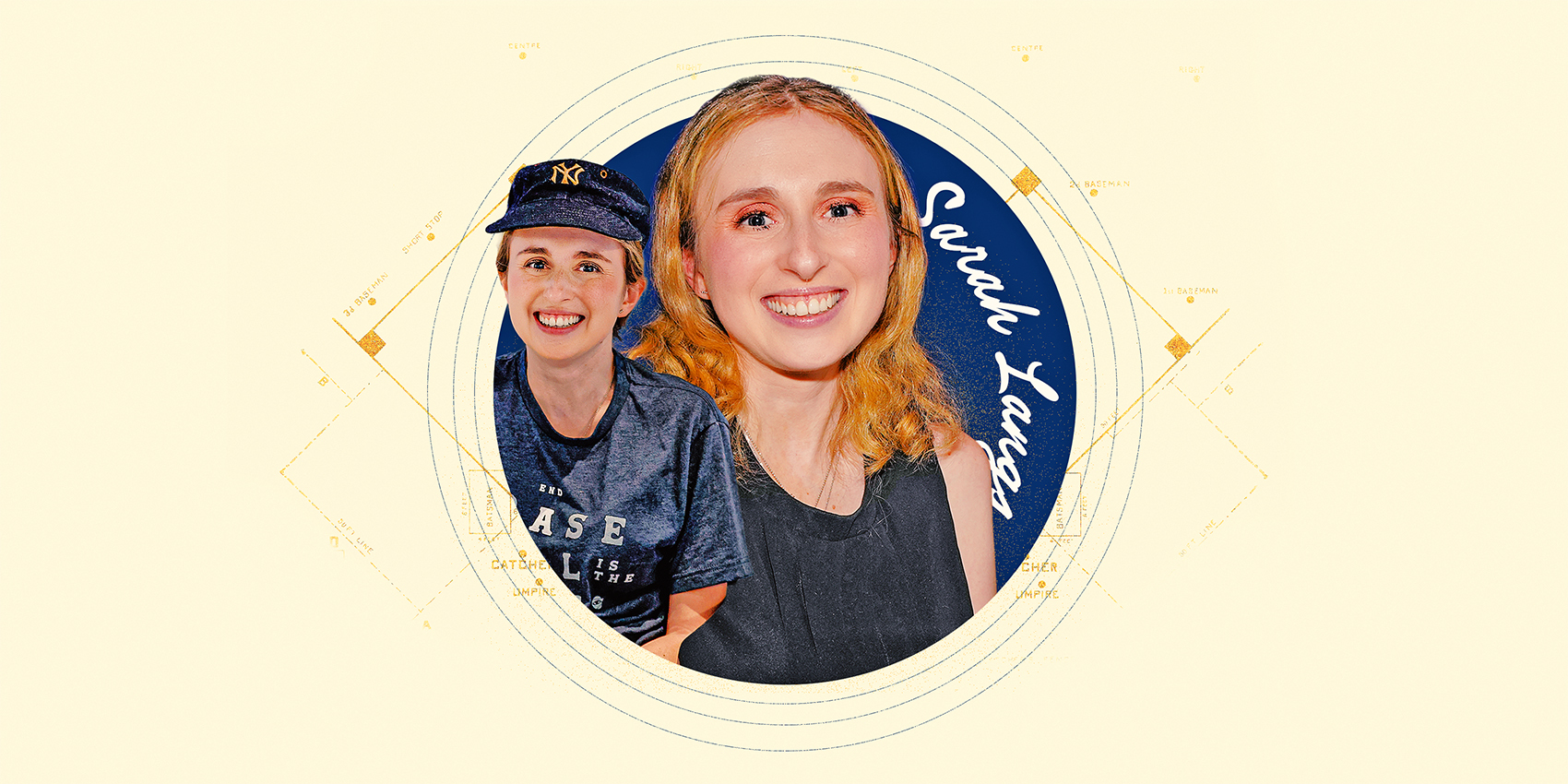
This reality has, in many ways, completely reoriented Langs’ world.
She was once a committed long-distance runner who finished multiple half-marathons. Now she gets around via wheelchair. It can be difficult for her to communicate verbally, particularly over the blasting beats of a pregame batting practice playlist. Travel is cumbersome, handshakes are tricky, regular TV appearances are no longer viable. As is the case for most individuals living with ALS, Sarah’s mobility and physical strength have gradually diminished, even though her mind is as sharp as ever.
Her diagnosis is, given her passion, all the more unfortunate. A statistical researcher — somebody who has dedicated her life to unearthing the unseen, discovering the hidden, solving the perplexing — has a disease with no known cure.
Yet ALS has not chipped away at her intellect or spirit or enthusiasm, nor has it limited the ferocity and consistency with which she approaches her work. That, to the people who have worked alongside her, is both remarkable and entirely predictable.
”If you didn’t know, you wouldn’t know,” Gregg Klayman, Langs’ longtime boss at MLB.com, recently told me over the phone. “She’s better at the job than she’s ever been.”
Play 2026 Soccer Pick 'Em with FOX One and make your picks for the world's biggest soccer tournament
But because of ALS, people at the ballpark occasionally mistake Langs for somebody who’s off the clock. Once, during batting practice, a player asked Sarah where she’d be during the game — would she be in a suite? Her boyfriend, Matt, gestured toward the press box and kindly explained that no, she would be working.
And Langs’ presence at the stadium — she has been at every World Series game since 2023 — is not a favor related to her health. She isn’t there as some kind of pick-me-up organized by a club’s community relations department.
Sarah Langs is there to do her job.
“I was doing this before I was diagnosed, and I’m still doing it now,” she told me. “ALS affects some nitty-gritty details, but it doesn’t have any bearing on what I do. A great note isn’t great because it came from someone with ALS — it just is. There’s no park adjustments.”
That sentiment highlights the line Langs has tried to toe since her diagnosis. She is willing and eager to be an ALS spokesperson. She has accepted myriad awards, given speeches, launched campaigns, sold T-shirts. On Lou Gehrig Day on June 2 — since 2021, MLB’s annual day to celebrate the Yankees legend and raise awareness of ALS — Langs will once again be advocating in the spotlight.
But at the same time, quite understandably, Sarah does not want to be known as “the researcher with ALS.” She wants her work, her personality, her relationships — not her condition — to define her.
Langs, like many of the laser-focused ballplayers she covers, is simply controlling what she can control: covering the sport to the best of her ability. That mission has provided her with an outlet, a purpose, a structure, a rhythm. That was true before her diagnosis, and it’s even truer now. Her situation is challenging, her disease is depleting, her life is far from simple. But Langs is no sob story, especially not in her own eyes.
Gratitude, not self-pity, shapes her view of the world.
“Just so grateful for baseball and the baseball community,” she said. “I always was, but I am even more so now. The support I’ve received from across the sport is truly beyond words. I often say baseball is the best because its people are the best, and I’ve been overwhelmed by the support — in a good way.
“And that spirit of support predates ALS, for the record.”