

SEC, Big Ten vs. everybody? 'Protect College Sports' bill politicians rail against Power 2 leagues in pivotal hearing
WASHINGTON — For years now, the Big Ten and SEC have distanced themselves from the rest of the college sports pack.
The leagues will soon distribute as much as $40 million more to their schools than any other conference; are compensating their rosters at least five times more in above-the-cap NIL dollars; signed 82 percent of the five-star football recruits last year; and have won 10 of the last 12 football national titles.
The divide has struck fear from those in the industry of an inevitable breakaway.
That theory has now reached the steps of the U.S. Capitol.
"They want to form a super league," Sen. Ted Cruz (R-Texas) told Yahoo Sports after a three-hour congressional hearing over the latest college sports legislation that he authored with Sen. Maria Cantwell (D-Wash.).
"The bill is explicit that they can't form a super league," Cruz said as he maneuvered within the Capitol corridors. "I love the SEC. I'm a Texan. I go every year to UT and A&M games and love them. But a super league would be devastating for the rest of the country and smaller programs in Texas. That would be a disaster."
Cruz's comments — biting allegations toward the richest and most powerful conferences in America — encapsulate a hearing in which he presided over on Wednesday before the Senate Commerce Committee. The committee controls college sports legislation and determines if the Cruz-Cantwell bill, the "Protect College Sports Act," advances through Congress.
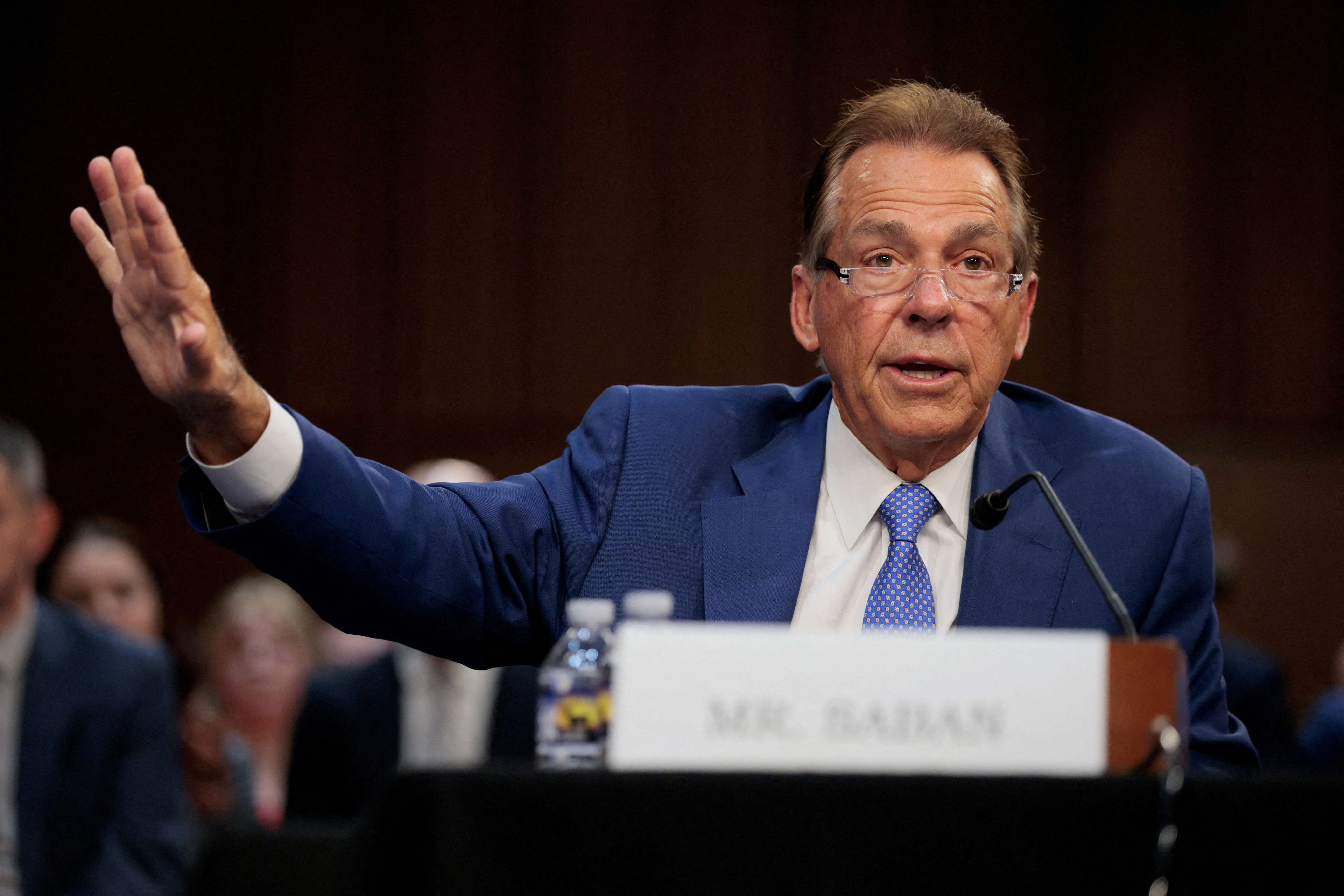
Within a packed committee room on Wednesday, senators openly discussed concepts of the bill with testifying witnesses — most notably Nick Saban — such as providing antitrust protections for the NCAA to reimplement its one-time transfer policy, create a five-year eligibility standard and strictly enforce the athlete revenue-share cap.
Though mostly a ho-hum affair, an unmistakable message emerged from lawmakers themselves: The SEC and Big Ten's growing resource advantage and continued consolidation of big brands must be stopped.
Play 2026 Soccer Pick 'Em with FOX One and make your picks for the world's biggest soccer tournament
Much of the discussion was emblematic of a bill that targets the industry's two titans, preventing them from merging and expanding and paving a path for FBS leagues to pool media rights — something those conferences adamantly oppose.
Lawmakers and witnesses uttered the words "super league" on Wednesday more than a dozen times — a theoretical concept in which the SEC and Big Ten consolidate their 34 schools (or more with expansion) in an NFL-style structure to increase media values and viewership.
But these allegations are unfounded, according to the Big Ten commissioner.
Reached for comment, Tony Petitti strongly rebuked any notion that his league is interested in forming a super league and says he is now "setting the record straight."
"Any statement that suggests the Big Ten is pursuing or wants a super league is a fabrication," Petitti said. "At no point in time have we discussed such a concept with the SEC or anyone else. Any suggestion otherwise comes from people outside our respective conferences."
At his league meetings last week, SEC commissioner Greg Sankey said he hoped that no further expansion unfolds and described his own conference as a "super league," suggesting no merger or future additions are planned.
In trying to prove his point, Petitti gestured toward the Big Ten's efforts in supporting a 24-team playoff as a way to provide more access to all leagues and potentially bring stability to the conference landscape. The Big Ten and SEC have no plans to merge, he re-emphasized, and instead are "looking to grow" the rivalry between the two conferences.
"The narrative over which league is better at any given moment is great for college sports," Petitti said.
SEC and Big Ten vs. Everybody?
Wednesday's back-and-forth banter served as the second such public exchange between a sitting U.S. senator and one of the country's premier college conferences.
On the eve of the hearing Tuesday, the SEC and Big Ten released a joint statement — an unusual move — opposing the bill as written. The statement sparked a reaction from Cruz later that evening in the form of a terse, 88-word response that notably mentioned a "Power 2 consolidation" that stands to further "destabilize college sports."
Battle lines are drawn.
In fact, at one point while leading the hearing, Cruz said a failure to pass congressional legislation would "kill off everyone but the SEC and Big Ten." And after the hearing, Cantwell said she and other lawmakers are "fighting the same challenge" as members of the Congressional Black Caucus, who are against support for college sports legislation in the wake of what they believe is the racially motivated redistricting of Southern states.
"We are [both] fighting the SEC," Cantwell told a small group of reporters.
There is more.
Cantwell suggested that the SEC and Big Ten may soon dismantle the ACC and Big 12 in a similar way in which the Big Ten raided the Pac-12, where Cantwell saw one of her state's programs, Washington State, abandoned.
"The ACC and Big 12 are saying, 'I don't want to be the Pac-12. Don't come and eat my best parts and leave me for scraps,'" she said after the hearing.
Even lawmakers like Sen. Eric Schmitt (R-Mo.), who acknowledges his love for the SEC and his home state program, Missouri, want a more level playing field across the landscape of college sports.
"I want there to be an opportunity for other schools to be able to compete," said Schmitt, a bill co-sponsor with Chris Coons (D-Del.).
The SEC and Big Ten seem to be a "one-man island," Cantwell added. The situation has already devolved into something she says she wanted to avoid: SEC and Big Ten versus Everybody.
"They have a different viewpoint," the lawmaker said.
Despite the words exchanged Tuesday and Wednesday, Cruz is scheduled to speak with Petitti and Sankey on Thursday in an effort to resolve their qualms with the legislation. However, there is little wiggle room with the portion of the bill that targets the two conferences, he and Cantwell both said.
Cantwell said she'd "definitely want to keep" in the bill the provision that offers schools the option to consolidate their media rights — a move that, in theory, will generate more revenue for schools rather than the current, piecemeal system of individual leagues striking TV agreements. The additional revenue, she said, would be dedicated to protecting the survival of Olympic and women's sports programs that are in jeopardy of elimination and defunding as schools dump more resources into football and men's basketball.
Cruz says the media rights pooling concept was "necessary" to reach a bipartisan agreement with Cantwell. According to the bill language, at least 75% of FBS, or 104 teams, must agree to the provision to trigger the antitrust protection and allow for the pooling of rights (the other 25% would not be forced into joining).
The SEC, Big Ten and Notre Dame — 35 schools total — can form a voting bloc to prevent such pooling. However, Cruz says, the pooling tactic will not generate the revenue bump without the Big Ten and SEC.
"The commissioners of the SEC and Big Ten don't like that we explicitly prohibit a super league and that we allow the collective pooling of media rights," Cruz told Yahoo Sports. "Most other conferences in the country have come out enthusiastically in support of the bill."
Though Schmitt emphasized that the rights-pooling concept is "totally voluntary," the bill is structured with an expectation that rights will eventually be pooled — perhaps after the final league TV contracts expire in eight to 10 years. After all, certain concepts in the bill are triggered only if rights are pooled, including the provision intended to protect women's and Olympic sports.
The provision requires schools to maintain their scholarship and roster funding for those sports programs — as long as rights are pooled. In a hint of impending changes, Cantwell suggested that provision may be untethered from the rights-pooling concept.
But, she asks, "Where then do you get that money" without consolidating media rights?
"Experts believe [pooling rights] can bring in an additional $4-8 billion," she said.
As a witness, former West Virginia and Ohio State president Gordon Gee urged college sports to "run through" the window of pooling rights before it closes. "There are those who don't want that window to remain open," Gee said, a clear shot toward the SEC and Big Ten.
"Either we grow the pie, or we destroy everything that we've built," Gee said.
Notre Dame athletic director Pete Bevacqua, a former NBC executive, cast doubt on projections of a large increase in media rights value from an FBS pooling of rights. What would increase value, he says, is to create a "super league" — that word again — of 24-30 schools and optimize schedules. He is against the super league notion but warned of its increasing possibility if legislation doesn't pass.
"You're going to only have a small number of universities who can invest to field a nationally competitive football team," he said.
'Strange bedfellows'
This is an awkward situation and highly unusual.
A piece of legislation has reached this point without the support of two of its most prominent stakeholders, who each find themselves now in a public fight with a leading member of the U.S. Congress, who has authored a bill that limits the future decisions of those stakeholders.
"It is a first in modern political history," said one longtime political powerbroker here.
Wednesday's hearing drew the rich and powerful.
Texas billionaire businessman Cody Campbell, a noted Cruz supporter, watched from an area of the committee room cordoned off by velvet ropes, a section normally reserved for special guests of lawmakers and those testifying as witnesses.
A few seats away sat several members of Smash Sports, the private-capital movement whose operatives have mostly worked silently behind the scenes for three years now socializing a model to reshape college football by consolidating media rights.
From a front-row seat, the Smash group — including a former Cruz staff member, a leading political lobbyist and an influential ex-congressman — listened intently as the proceedings unfolded, even exchanging pleasantries with Cruz himself afterward.
They got to witness America's greatest living football coach speak in Congress.
Saban issued strong support for a bill that his former conference (SEC) and current employer (ESPN) hold some opposition to — a stirring move that may have far and wide ramifications. While supportive of players earning compensation, Saban bemoaned the industry's lack of rule enforcement and a central governance system. He called upon Congress to create a college sports "commissioner" to bring together a fractured environment of competitive schools and conferences attempting to out-spend one another.
"If you had the biggest, baddest Ferrari and it was going 100 miles an hour toward the Grand Canyon, you need to tap the brakes," he said. "I think that's what we all need to do here."
If the Ferrari reaches the canyon, college athletics will be "left with 30-50 teams in a mini NFL," said Cruz, another reference to a super league. "The victims will be fans and hundreds of thousands of student-athletes who will lose scholarship opportunities."
The SEC and Big Ten are not alone in their opposition of the bill. Many Democrats are against legislation that may limit athlete movement and compensation and believe that employment and collective bargaining — not congressional action — are the only ways forward.
For very different reasons, the SEC and Big Ten find themselves in opposition of their long-sought legislation with the likes of the Congressional Black Caucus and Democrat senators like Chris Murphy and Cory Booker.
"Weird bedfellows," said one person here Wednesday.
Republicans aren't all on board either. Bernie Moreno (R-Ohio) released a statement after the hearing that he refuses to support a bill that doesn't address a perceived transgender issue.
The pushback did nothing to impact the confidence from the bill's authors in its passage. Cruz hopes the legislation will "swiftly" reach the next stage in the approval process: a "markup" session before committee members where they suggest amendments. Such a session was originally scheduled for next Wednesday, though no formal announcement has been made.
As the hearing Wednesday wrapped up, Cantwell stepped aside to take additional questions. A small crowd gathered before the first inquiry: What's your reaction to the SEC and Big Ten's opposition?
"If senator Cruz and I, who disagree on a lot of things, can figure out how to agree, why can't you guys fix this within your system of conferences and presidents?" she asked. "Why can't you guys figure this out? It wasn't that hard."