

U.S. Open: Why Shinnecock's shortest hole strikes fear into the world's best golfers
SOUTHAMPTON, N.Y. — Brooks Koepka held his wedge across his back after his follow through with a suspicion about what was going to happen to his tee shot. Ahead of Dustin Johnson and Tommy Fleetwood by two shots in the final round and on the 11th hole, the 2018 U.S. Open leader knew now was not a time for mistakes. Everyone is aware that at Shinnecock Hills bad mistakes can get compounded.
Koepka kept his eyes on his ball, hoping he could somehow will it to land in a nice spot on No. 11's narrow green and avoid the deep bunkers that guard it.
After the ball had reached its apex and began its descent, Koepka came to terms with the outcome he had tried to avoid and expressed his thoughts aloud, which were captured by Fox's microphones.
"Oh, no."
Koepka's ball overshot the green, landed into a low basin and stopped in what Brad Faxon called "the thick garbage." Compounding that outcome, Koepka's second shot was an uphill pitch that bounced three times before reaching the green, but had too much speed behind it and rolled across the green and into a bunker.
The hole would be saved as Koepka escaped the bunker and sunk a 12-foot putt, which was followed up by an emphatic, relief-filled fist pump to finish with a "great" bogey, as he would later describe it.
"I think that was big because, from where we were, I want to say I would have taken double when we were in jail. You can't miss it there," said Koepka, who would win the tournament after finishing 1-over par, one shot better than Fleetwood. "To make that big of a mistake, you just want to walk away with bogey. Luckily, that putt went in, and that built some momentum coming down the stretch and made me feel a little bit better with the putter."
Koepka was fortunate. The "shortest par-5 in golf," as Lee Trevino once dubbed it, wasn't kind to many that weekend. Players at the 2018 U.S. Open — the last played at Shinnenock — recorded a 3.28 stroke average with 125 bogeys and 16 double bogeys or worse, according to Data Golf.
Play Golf Pick 'Em now to make your predictions for the U.S. Open!
That fits with the reputation of Shinnecock Hills being a tough course and why it's in the United States Golf Association's rotation. The place can put fear into you as it provides headaches and makes you pay for bad decisions. The winning scores in the past four U.S. Opens held at the course on the east end of Long Island were 1-over, 4-under, even, and 1-under.
When they say, "Let Shinnecock be Shinnecock," that means do not expect a birdie fest, which no one is expecting this week as the U.S. Open returns to the diabolical course once again.
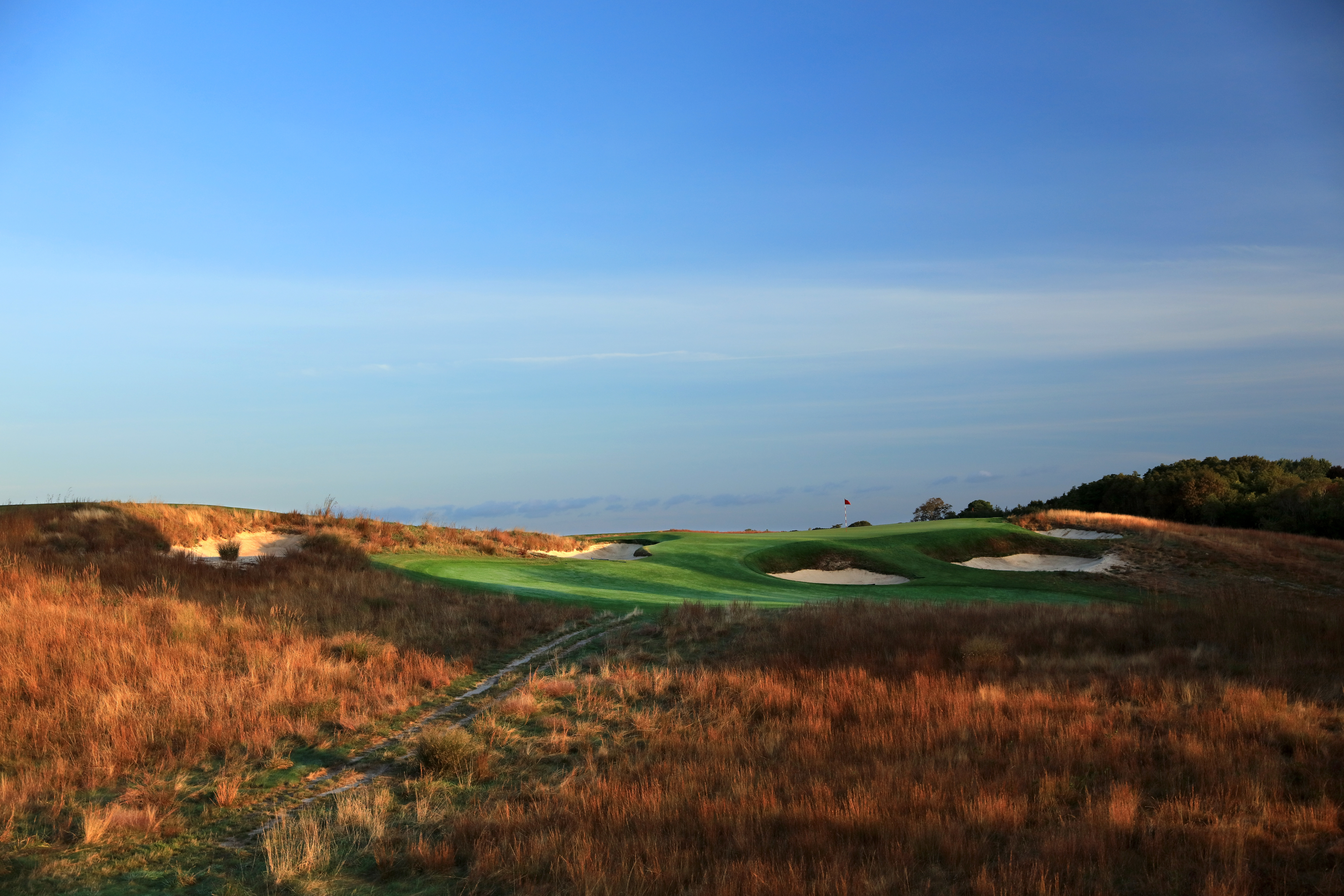
When you step into the tee box at No. 11, known as "Hill Head," the scenarios play out in your mind all at once. The hole will play around 157 yards this week, but about 50 of those yards are uphill toward a green where only the front edge is visible. As players cycle through thoughts about how to approach what lies ahead, they also have to factor in winds that will whip in from the Atlantic Ocean and Peconic Bay.
There are four deep bunkers that sit in front of the green, adding even more pressure on the shot. You might think to play it short, but the right-angled tilt in front of the bunkers will only force players to make another intimidating uphill shot.
"I think it's fascinating," said Adam Scott, who missed cuts at the 2004 and 2018 U.S. Opens at Shinnecock Hills. "We've got a short hole, a short par 3, and you're really scared on the tee, and you've got a 9-iron maybe. So we play so many 220-yard par-3s over water. I think the fact that a 150-yard hole scares us is brilliant."
"I think the green complex is so undulating, so small, it's very difficult," Koepka said on Tuesday. "If you're going to miss it, you've got to miss it right. I think that's the first thing you've got to do. From there, it's just a good par 3. You've got to be precise with your distance and your accuracy. I think it's a good challenging hole, and you can walk away with 5 very easily."
Shinnecock Hills Golf Club was built in 1891 and became one of the five founding member clubs of the USGA. Originally a 12-hole course, six holes were added in 1895. Four revisions later, all by designer William Flynn, the course gives players an almost links-like experience.
For No. 11 specifically, it has changed some over time, but the design has remained the same. Its features are what set it apart from other notable par-3s.
"It's a very different kind of a par-3 than what [PGA Tour players] are really used to seeing," author and writer Phil Carlucci, who runs the website Golf on Long Island, told Yahoo Sports recently. "How often on tour do you really come across a blind par-3 where the design of the hole, it's got bunkers in front and the slope long, but it's not like it's that crazy of a design.
"But the fact that it's uphill, blind, it's at a spot on the course that's pretty exposed to the wind. All those sections on the back where you have elevated tees and greens. You're basically getting the full-brunt of the wind. You might not feel the wind as much on the tee. But once the ball is in the air it's out of your hands. It's whatever the wind is doing up there. It encapsulates a lot about Shinnecock as a whole."
Practice rounds this week have been used to get accustomed to the winds — learning their strength and direction depending on the time of day. But Shinnecock being Shinnecock, the wind you get on Monday and Tuesday will likely not be the same you have to face on Saturday and Sunday.
Even with advances in golf club technology and players stronger than ever, playing No. 11 requires skill, a deft touch and a few prayers that you've caught a pause in the wind as your ball ascends towards the hole.
"That's part of the genius of the design," Carlucci says, "is that even a course that was built almost 100 years ago [after Flynn's 1931 redesign] has some shots where even if the game is completely changed, equipment-wise and all that, you're still facing that same test. It's a matter of whether or not you're going to past that test."