

World Cup 2026: How do yellow and red cards work?
Every four years a new set of fans unfamiliar with the sport of soccer (or football, in most parts of the world) settles in for a month consuming "The Beautiful Game." Inevitably, questions arise when a referee reaches into his front or back pocket and pulls out a card.
The origin story actually involves a traffic light. As the inventor of the card system, Ken Aston, says of his attempts to develop a tiered, cautionary punishment system: "As I drove down Kensington High Street, the traffic light turned red. I thought, 'Yellow, take it easy; red, stop, you're off.'"
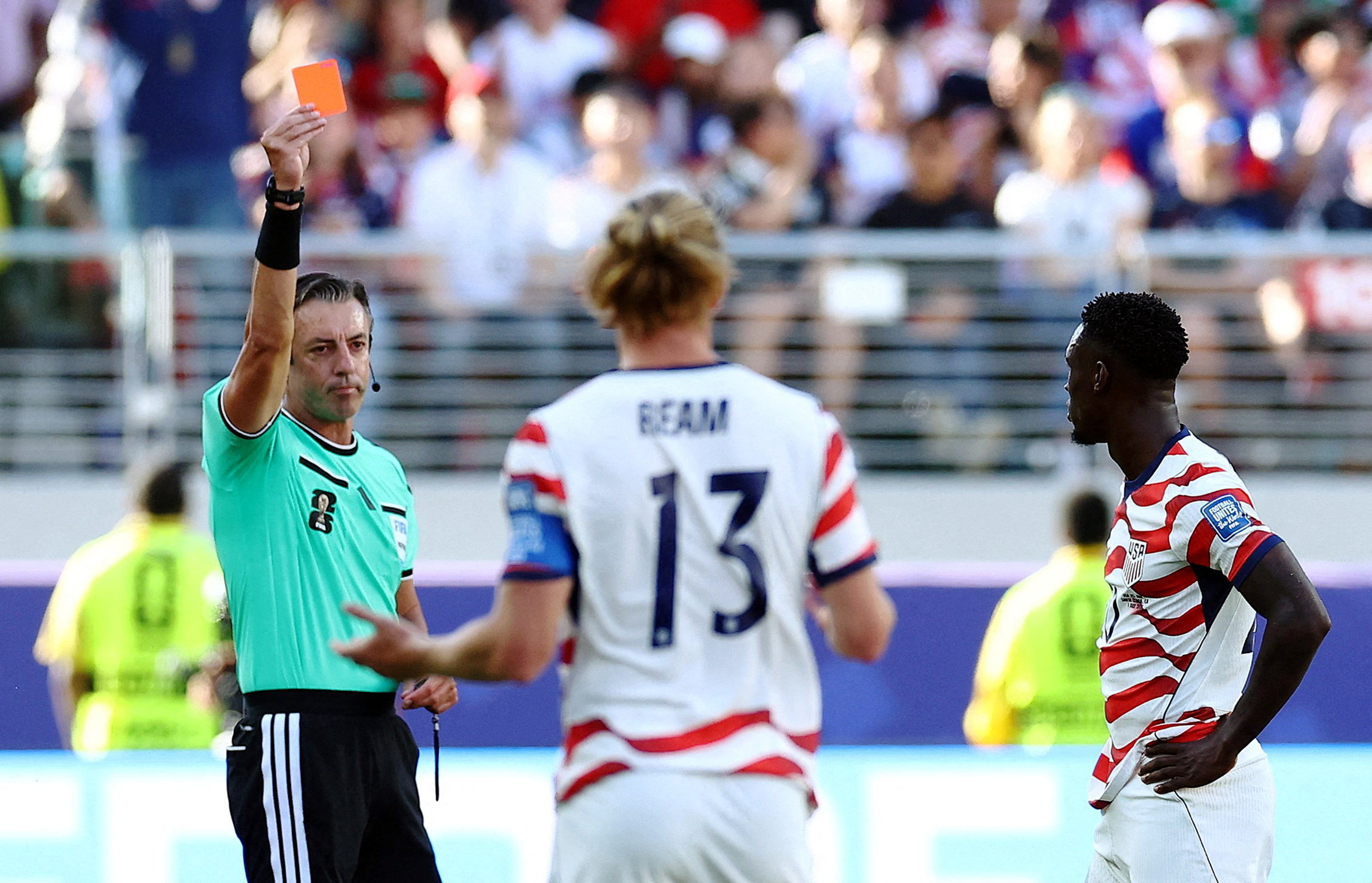
There you have it. Red cards are what American sports refer to as ejections. Yellow cards are the in-between. If a player receives two yellows in the same game, a red accompanies the second one.
And there's one key difference from American sports ejections. If a player sees red, his or her team must play the rest of the game down a player (10-on-11). It also warrants a one-game suspension for the player, to be served in the next international competition. (USMNT's Folarin Balogun, for example, will miss the USA's match against Belgium in the Round of 16 on Monday after a video review ruled he'd stepped on an opponent's ankle.)
FIFA's own rulebook says, "A sending-off automatically incurs suspension from the subsequent match. The FIFA judicial bodies may impose additional match suspensions and other disciplinary measures."
So … uh … what are the rules?
In a weird way, many foul calls are subjective. The rulebook says the ref should blow his whistle for a foul when a player "charges, jumps at, kicks, attempts to kick, pushes, strikes, attempts to strike, head-butts, tackles, challenges, trips or attempts to trip" an opponent" in a manner considered by the referee to be careless, reckless or using excessive force."
There are further definitions for "careless" and "reckless" as well. And then there are specific mentions of biting and spitting, among other things. But you really just have to watch and learn what the threshold is.
And what's the punishment?
In the event of most fouls, the opposing team gets a free kick — an opportunity to pass or shoot a still ball under no pressure. More serious fouls draw yellow and red cards. And if the foul occurs in a penalty box at either end of the field, it results in a penalty kick: a free shot from 12 yards out, middle of the goal, only the keeper to beat. Roughly three-quarters of penalties are converted.
What types of fouls draw yellow and red cards?
Yellows are handed out in cases of delay of game, dissent, unsportsmanlike behavior, excessive celebration and "simulation" — also known as diving or flopping. They're also for reckless tackles and fouls that halt a promising attack, or for an accumulation of fouls by a single individual.
Red card offenses include, but are not limited to, "serious foul play," the denying of an obvious goalscoring opportunity (DOGSO), "violent conduct," offensive gestures or language, biting (colloquially known as the Luis Suarez rule) and spitting at someone. Even covering your mouth to say something to an opponent can be a red card offense. All of these are further defined in the International Football Association Board's Laws of the Game. But again, many require subjective judgement.
Some other notes:
If a player commits a foul and denies an obvious goal-scoring opportunity in the penalty box, and if the player made a genuine attempt to play the ball, the DOGSO provision gets overruled. The attacking team gets the penalty kick, but the player only receives a yellow card, not a red.
A referee can play advantage on a yellow card foul, then wait until the next stoppage to go back and issue the yellow.
The laws of the game specifically state that the following should not be the case, but referees often raise the yellow card threshold if a player is already on a yellow — and, therefore, if another yellow would bring out a red.
Red cards given at the 2026 World Cup
Sphephelo Sithole, South Africa
Themba Zwane, South Africa
César Montes, Mexico
Tarik Muharemović, Bosnia and Herzegovina
Homam Ahmed, Qatar
Hassim Madibo, Qatar
Miguel Almiron, Paraguay
Nathan Ngoy, Belgium
Rebin Sulaka, Iraq
Agustín Canobbio, Uruguay
Piero Hincapié, Ecuador
Folarin Balogun, USA