

Fantasy Baseball Skill and Luck Factors: Luis García Jr. worth exploring via trade on high-powered Nationals' offense
Apparently, when I raise concerns about a hitter, they start to shove it in my face. Last week, I expressed concerns with Kyle Tucker. However, Tucker has been hitting .400 since July 1. Like usual, we’re examining a hitter’s skill and luck factors to figure out whether we should buy, sell or hold based on their current production. Sometimes, struggling hitters present a buy-low opportunity. Meanwhile, hitters could be riding hot, but the underlying metrics say be cautious or buy high if possible.
Junior Caminero, 3B, Rays (99% Rostered)
Caminero has been a rockstar this season, building upon his peak year in 2025. He has been walking more (12.5%), which would be a career high. That’s partly because Caminero is being more patient, with a 29.1% chase rate and 60.1% zone swing rate. For context, Caminero’s chase rate was three points lower and the zone swing rate dropped by five percentage points. That said, Caminero is using a more patient approach this year.
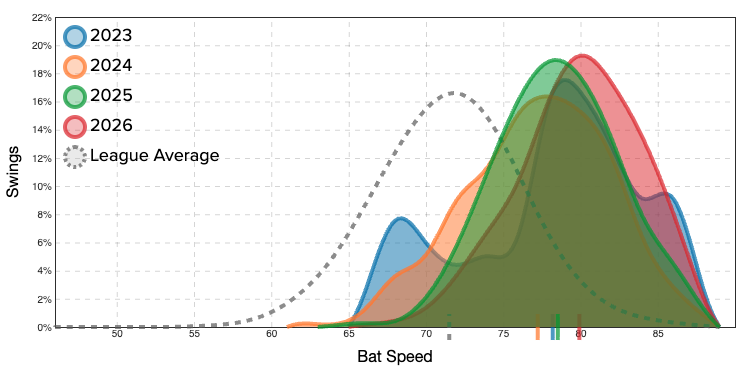
Caminero consistently pulls the ball into the air 24% of the time, up from 21.5% (2025). The power metrics have been off the charts, given Caminero’s elite bat speed (79.9 mph), 88% fast swing rate (percentage of swings at 75 mph or higher) and an 8.9% barrel rate per plate appearance. Though Caminero’s 28% home run per flyball rate (HR/F) seems high, hitters with elite power can maintain higher home run rates.
The projections point toward Caminero pushing toward 50 home runs with a .280 batting average, making him an elite four-category contributor. Furthermore, if Caminero maintains his more patient approach and double-digit walk rate, he will be an asset in points and OBP leagues. Caminero is teasing us with a light version of Aaron Judge.
Luis García Jr., 1B/2B, Nationals (78% Rostered)
The Nationals have been mostly playing García in a strong-side platoon role, though he often bats in the top third of the lineup. In a half-season, García has already set his career high in home runs (20), so he is reaching new heights this season. He has been swinging the bat harder (73.6 mph) with a career-best 8.5% barrel rate per plate appearance this season. That supports García’s home runs in the first half of the season.
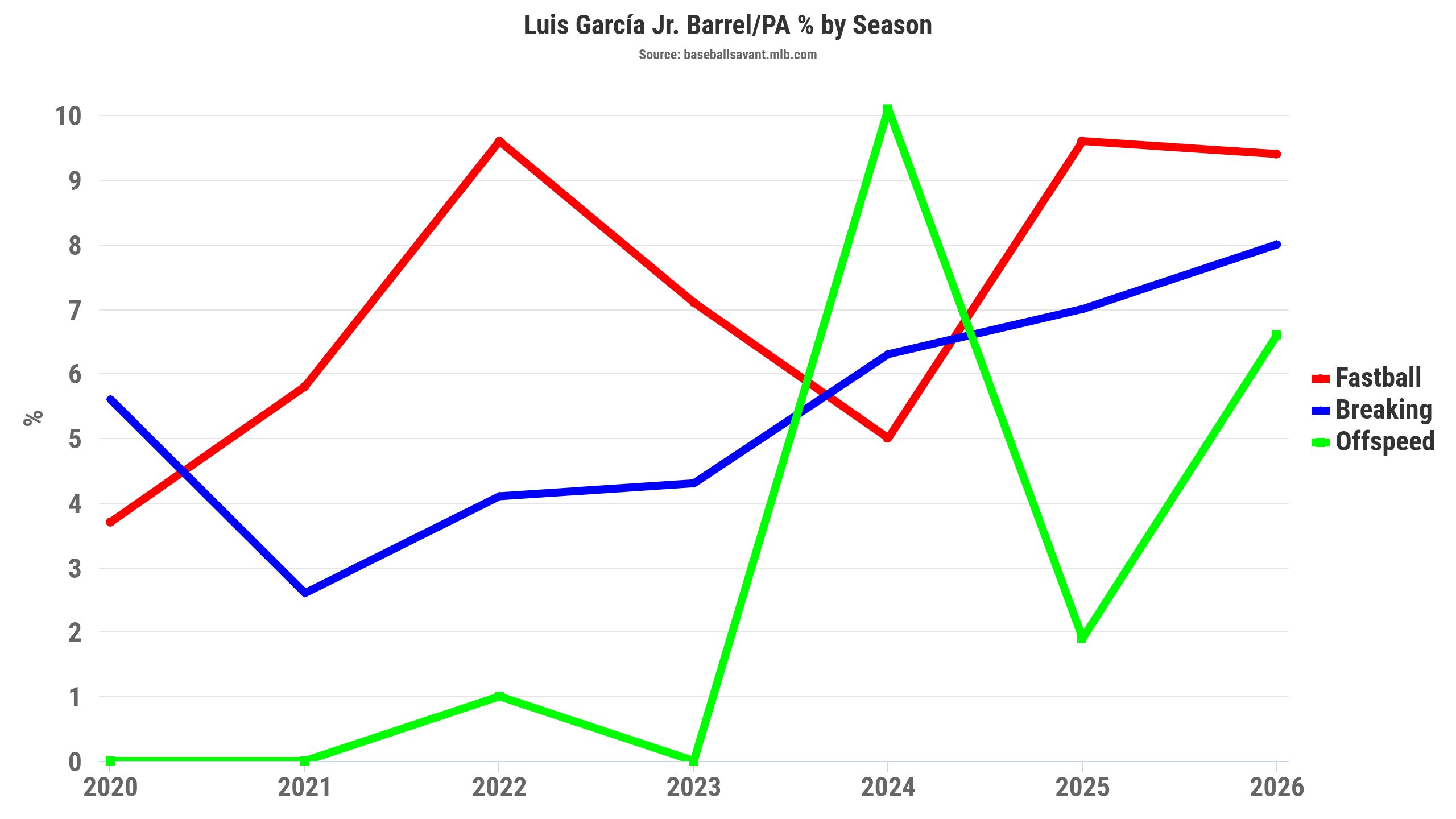
However, since García doesn’t have near-elite or elite power skills, it’s unlikely to have his HR/F at 23%, which is over 10 points above his career average. That’s especially true because García’s 17.4% pulled air rate is near the league norm. García possesses above-average power skills, but the 43.5% groundball rate will impact the power ceiling. He had a 94.5 mph average exit velocity on flyballs and line drives last year, which increased by nearly one mph this season (95.7 mph, No. 43). Overall, García is hitting the ball hard and barreling the ball, which supports the early home run output.
After 22 steals in 2024 and 14 in 2025, García’s steals have plummeted, as he projects for 9-10 this season. That aligns with García’s stolen base opportunity rate went from 21% (2024) to 18% (2025), then a lowly 8% (2026). He converted as many of his stolen base chances in 2024 and 2025 (78.3%), so he wasn’t inefficient with his opportunities.
First-year manager Blake Butera took over this season, so there’s a chance it’s a managerial tendency or a player-level change, since García ranked in the bottom-third percentile in Sprint Speed. However, 25-28 home runs, 7-8 stolen bases and a .280 batting average suggest García is an above-average hitter to potentially acquire via trade.
Nick Gonzales, 2B/3B/SS, Pirates (28% Rostered)
Though Gonzales is probably underperforming relative to expectations as a first-round pick in the 2020 MLB Draft, he is providing batting average for the Pirates while hitting in the middle of the lineup. Gonzales’s .376 BABIP is boosting his .311 batting average this season. Both Gonzales’s BABIP and batting average have been 30-40 points above his career norm.
He has been showing similar plate-discipline numbers, with a 78.6% contact rate and an 11.3% swinging-strike rate. Gonzales’s contact and swinging-strike rates are 1-2 percentage points within his career averages. His 12.2% pulled-air rate is lower than his 16% from last season. That directly impacts his below-average power skills, given his 2% barrel rate per plate appearance, nearly three points below the league average.
Unsurprisingly, Gonzales hasn’t hit double-digit home runs in his career, with league-average power typically leading toward 15 home runs. The projections expect his batting average to regress to .270 (near his career average), seven home runs and six stolen bases. Gonzales still profiles as a deep-league hitter to stream, rather than a reliable fantasy asset.
Cody Bellinger, OF, Yankees (98% Rostered)
In Bellinger’s second season with the Yankees, he is flashing power and speed. His 13% walk rate spiked to the highest since 2019, suggesting a more patient approach. Bellinger’s 45.1% swing and 62.7% zone swing rates have been 3-4 percentage points below his career norm, aligning with the walk rate increase. That hasn’t led to a significant increase in his OBP, though he typically performed well in points and OBP formats.
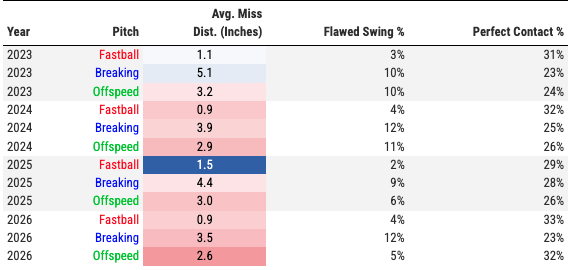
Bellinger continues to pull the ball in the air at an above-average rate (21.7%) while maintaining a decent, but not mind-blowing, 5.1% barrel rate per plate appearance. Breaking and offspeed pitches have been giving Bellinger problems, via the new swing timing metrics. Bellinger has an 3.5 inch average miss distance on breaking pitches with 2.6 inches against offspeed ones this season. That’s similar to the previous seasons, as he tends to swing over the breaking and offspeed pitches.
Maybe the new swing timing metrics are noisy because Bellinger plays in a hitter-friendly ballpark, especially for left-handed hitters. The projections expect Bellinger to post 24-25 home runs and 15-16 stolen bases with a .250-.260 batting average. That’s a valuable fantasy asset as a five-category contributor, though he tends to need volume to reach those outcomes.
Ryan O’Hearn, 1B/OF, Pirates (65% Rostered)
I drafted this before O’Hearn blasted three home runs in a game, so it’s hard not to have additional optimism here. After playing with the Royals for five seasons, O’Hearn jumped around to three teams across the past four seasons. One way to describe O’Hearn is steady, as a four-category contributor, though none of them blow you away. O’Hearn projects to surpass his career high in home runs, expecting to hit around 25 this season, with a career high of 17 in 2025.
Though O’Hearn’s 6.3% barrel rate per plate appearance doesn’t excite us, he is pulling the ball into the air (19%) more often, up nearly four points from his career average. Theoretically, more pulled batted balls into the air should lead to more home runs. However, O’Hearn’s barrel rates and exit velocities on flyballs and linedrives have been similar to recent seasons.
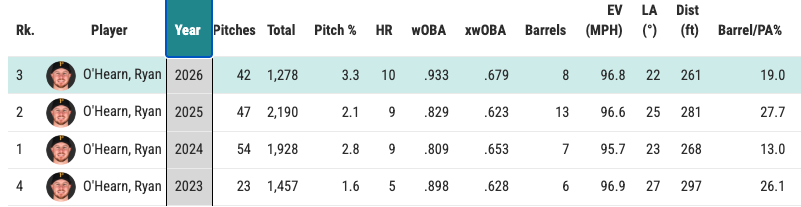
For context, O’Hearn’s 96.8 mph exit velocity on pulled flyballs and line drives has been similar to the career averages. However, O’Hearn’s batted balls have been traveling 20 feet fewer on average compared to 2025 (281 feet) when he pulls them. With the baseballs having less drag, there’s a chance those numbers shift favorably for O’Hearn to hit more home runs when he pulls the ball into the air.
The Yahoo roster percentages being around 70% should tell us that he provides value in shallow, medium and deep league formats. O’Hearn rarely sits against lefties, so he is valuable in daily and weekly lineup leagues. I would be buying O’Hearn in medium-sized leagues with five outfielders or a corner infield spot, but he might lack value in head-to-head formats, given the steady profile.