

Congress looks to rewrite college sports bill in high-stakes push to win SEC, Big Ten support before time runs out
WASHINGTON, D.C. — Lawmakers are working towards revisions to the Protect College Sports Act in an effort to gain the support of major stakeholders within the industry.
That includes adjusting the bill’s expansion concept to permit non-power conference schools to join, if invited, the Big Ten, ACC, Big 12 and SEC, according to Sen. Maria Cantwell, a Washington Democrat and co-author of the legislation with Sens. Ted Cruz (R-Texas) and Eric Schmitt (R-Missouri).
“I want teams to be able to move where they want to like Washington State,” Cantwell told Yahoo Sports on Thursday in the U.S. Capitol. “We’ll get an adjustment to that language.”
The change is one of many under discussion among Cantwell and lawmakers as they work on a revised bill with a goal of garnering support from the SEC and Big Ten, the industry’s most valuable stakeholders that have, so far, opposed the legislation as currently written.
The discussions unfold at a pivotal time for the future of college athletics on Capitol Hill.
Time is of the essence
A short window — over the next three weeks — exists for the legislation to move to the U.S. Senate floor before lawmakers break for a month-long recess on Aug. 7. This week brought a flurry of communication between the three senators and college stakeholders on potential bill revisions, including direct conversations with commissioners of the Big Ten and SEC.
In a call with multiple conference commissioners on Tuesday, in fact, Cruz expressed a plan for a Senate floor vote as soon as next week — an ambitious but not impossible task. A more realistic timeline is the week of July 27 or Aug. 3.
However, the bill’s fate may depend on support from the SEC and Big Ten, which is contingent on revisions that lawmakers are actively exploring.
For many college football fans, the bill’s anti-expansion provision was one of the most jarring concepts within the legislation.
The original language of the provision froze power conference membership at its current state, rendering it impossible for those from the Football Bowl Subdivision’s mid-major six conferences (American, Sun Belt, Pac-12, Conference USA, MAC and Mountain West) to move upward. An impending change to the provision will give those programs the ability for promotion, according to Cantwell and other lawmakers and staff members who spoke to Yahoo Sports.
In addition to that, the revision may provide flexibility for power conference programs to move to other power leagues, such as those in the ACC and Big 12 shifting to the SEC and Big Ten. But those moves may only be made within a certain framework of parameters yet to be formalized. The revision is also expected to include language prohibiting third-party entities, such as private-equity groups, from forming a super league by poaching 20-30 of the biggest brands in the sport — an ask of the SEC and Big Ten that the Senate Commerce Committee agreed to last month.
As of Thursday evening, lawmakers had not finalized many of the revisions as they continue to undergo changes. Once finalized, they are expected to be sent to leaders of the SEC and Big Ten, as well as other conference offices.
“There have been a lot of really good conversations this week,” Schmitt told Yahoo Sports on Thursday from the Capitol. “Sen. Cruz, Cantwell and myself have been talking to a lot of people who care a lot about this. We’re really trying to get to a place where we have as much agreement as we can possibly have. Most people want to get something done.”
Also at the center of conversations around the revisions is finding a solution to clarify another provision that may limit compensation to athletes. The provision, as detailed in a June story, creates a more strict compensation cap by including all athlete NIL deals with associated entities — mostly from multi-media rights partners (MMR) — into the cap itself. While preventing a work-around of schools using MMRs and university sponsors to circumvent the cap, the move may deprive players of millions of dollars.
Solutions include adding language into the bill to expand the cap or at least offer flexibility to schools by adding new cap-related rules.
“I think the language we added right before the markup (vote) confused it to make every activity that an MMR does (as an) associated entity and thus under the cap,” Cantwell said. “When in reality, I think some of that activity isn’t, but it has to have a valid business purpose. We’re trying to get things like that right.”
This is a crucial juncture in the history of the college sports industry — one left rudderless, with few rules and enforcement, in the wake of mounting legal losses and decades of inaction from its own executives.
Conference leaders are gearing up to review any revised Senate bill. If Congressional action is non-existent or inadequate, leaders of the SEC are seriously considering an alternative route. “Plan B,” as some have referred to it, is a self-governance model in which the conference would establish its own rules, enforce those rules and even compete against only itself. League officials believe the strategy, as it applies to a smaller subset of programs, may avoid many legal challenges that crippled the NCAA’s amateurism rules.
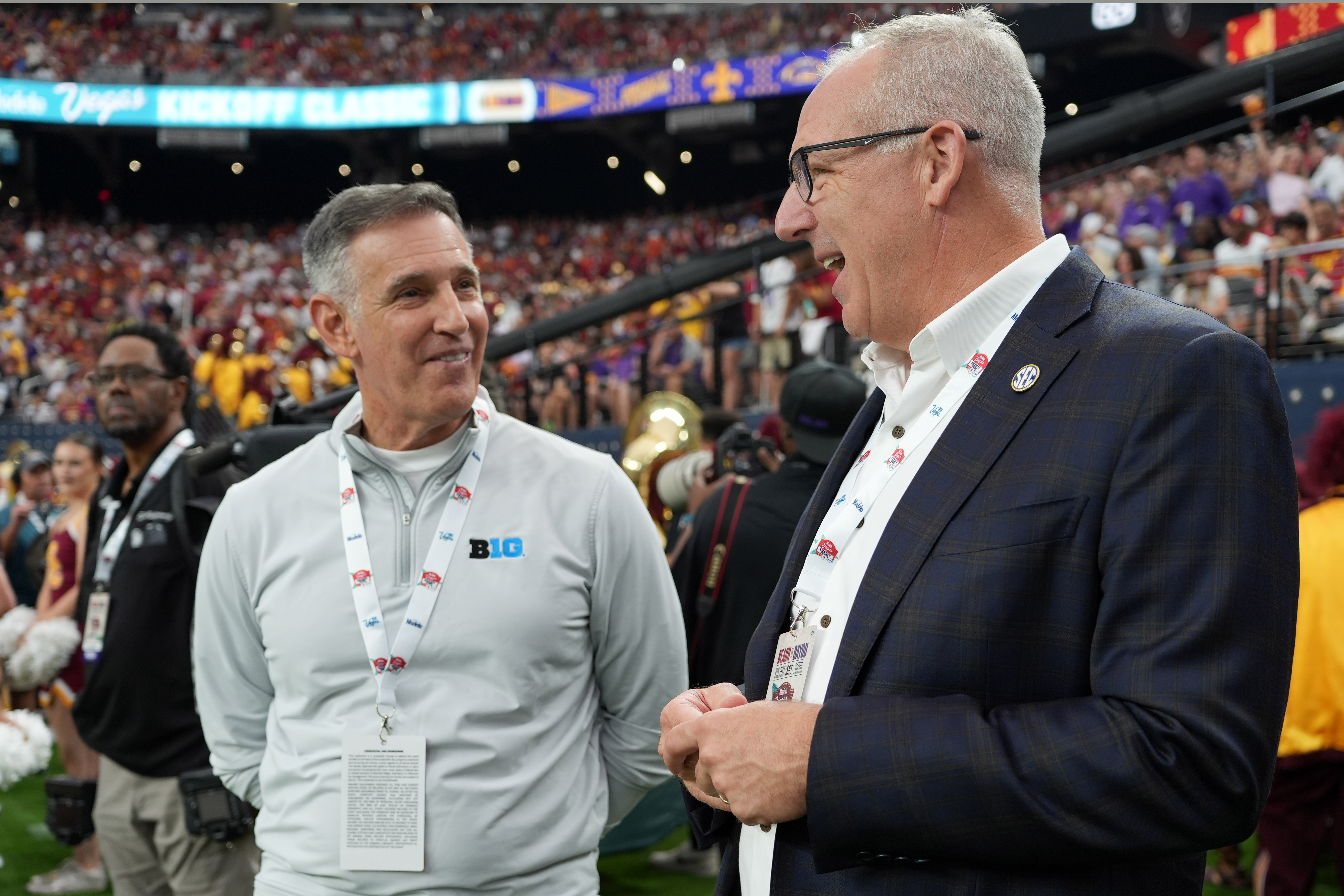
In fact, SEC commissioner Greg Sankey provided Congressional updates to his athletic directors and university presidents on Thursday, where officials continued discussion over “Plan B.” However, league leaders prefer a legislative solution and expressed a continued commitment — for now — in working with lawmakers over what they believe would be a sustainable bill.
“We are giving Congress time,” said one school official with knowledge of the meetings.
Time, though, is slipping away. Even lawmakers know that.
The month-long August recess gives way to a stretch of time proceeding the November midterm elections, at which point most Congressional action slows to a crawl. If the bill passes the Senate, it must then pass the House, where that chambers’ leadership has expressed opposition over the legislation.
“We’ve got a tight time frame, but everybody’s got to give us some time and space to educate the rest of our colleagues and hopefully get that moment,” Cantwell said.
“We are continuing to work, if that means over the weekend,” said Schmitt. “The safest route for us is to have as much time as possible and not let this go too late into July.”
Lawmakers are in a tricky place
While gaining the support of some stakeholders, the revisions put at risk others, especially Democratic lawmakers whose appetite is already thin for a bill that limits athlete movement, grants a degree of legal protection to the NCAA and may implement a stricter cap on players.
“You’ve got to make sure that you are doing it in a way to gain more support, not detracting,” Schmitt emphasized.
The legislation needs 60 votes in the 100-member chamber with a three-person Republican majority. And while six Democrats supported the legislation in a 19-9 vote in a Senate committee last month, many lawmakers hold opposition to the bill, including Republicans like Sen. Bill Cassidy (R-La.).
The bill does not address college athlete employment like its sister legislation, the SCORE Act. The SCORE Act, which failed in the House, prohibited athletes from being deemed employees. However, as part of a compromise that Cruz made during negotiations with Cantwell, the Senate bill is silent on employment, which Cassidy describes as a “huge issue.” Cassidy, chair of the Senate Health, Education, Labor and Pensions Committee, is “working” toward an amendment to the bill related to employment.
“We’ve got to get something that can pass,” he said, likely a nod to Democrats’ resistance to support any anti-employment provision.
Other outstanding issues
Beyond employment, there are other outstanding issues for the Big Ten and SEC.
The leagues have suggested changes to the primary portion of the legislation that permits the NCAA and conferences to re-implement the one-time transfer limit and five-year eligibility standard. The conferences want the legal protection strengthened by broadening a concept within the bill that preempts NIL state laws and narrowing the ability for athletes to take legal action in state courts — all changes that may put at risk Democrat votes.
The bill has created a fascinating dynamic. Instead of dividing lawmakers along party lines, the legislation has struck at the heart of legislators’ cultural relationship with their state universities: Will they side with their state’s SEC or Big Ten programs that oppose the bill over the other state universities that support it?
“I’m not sure we need (the SEC and Big Ten) to pass the bill, but to me, I’d like to get to a place where we can accommodate their reasonable concerns,” Schmitt said. “That’s a much better product for me.”
Schmitt has spoken directly to President Donald Trump recently and “he is committed to this,” the lawmaker said.
While senators hold confidence in gaining the 60-vote threshold, the goal is to pass the legislation with more than a two-thirds majority to send a resounding message to the other chamber.
“The thinking is to have as broad of a coalition as we can have on the Senate side,” Schmitt said. “It provides momentum on the House side.”