

College Fantasy Football 101: Learn how to play Yahoo's newest game

Since I started playing the greatest fantasy sport known to mankind, College Fantasy Football, back in 2001, our beloved hobby has toiled in obscurity behind its big brother, the NFL. In the early years of the game, heretofore known as the "Era of the Hawaii & Texas Tech Quarterbacks," it was an annual ritual to frantically search the web for any random stat service that could process college football leagues.
After years of living in the shadows, frustrated CFF enthusiasts have been hoping a major fantasy platform would offer customizable, easy-to-join leagues so we can finally expand the reach and awareness of college fantasy. We are proud to announce that Yahoo believes in the passion of the college fantasy football fanbase and wants to bring the game to the mainstream.
With the awareness of CFF's existence and the massive 68-team player pool being the biggest barrier to its growth thus far, Yahoo is committed to offering a comprehensive set of rankings, analysis and strategy articles to help guide even the most inexperienced CFF first-timer to compete for a College Fantasy Football Championship in Year 1.
Play Yahoo College Fantasy Football: Create or join a league for this season!
And with that, let's dig into some of the basics of playing College Fantasy Football on Yahoo. We'll cover similarities and differences between college and NFL here and go deeper on several topics in one-off stories in the weeks to come.
What's the same?
Scoring and Lineup
You will notice that the scoring system is very similar to NFL fantasy, with every 25 rushing/receiving yards earning 1 point and 25 passing yards accounting for 1 point. Customizable scoring allows you to adjust between 6 points per passing touchdown or the default 4 points per touchdown.
Default Yahoo leagues will start one quarterback and two flexes, but the 68-team talent pool makes starting two quarterbacks a completely realistic weekly option if you choose. Standard 12-team leagues feature a weekly starting lineup of two running backs, two wide receivers, one tight end, two flex spots, a defense and a new Team Offense position (which we will discuss in more detail shortly). Outside of the Team Offense position and no kicker, the starting lineup positions will closely mirror what most fantasy managers are accustomed to with the NFL version of our game.
Default Starting Roster
What's different?
How the Team Offense will work
The Team Offense position is designed to reward efficient, high-scoring units that minimize mistakes while continuing to play at a high level for 60 minutes each week, including second-stringers and freshmen who are salting games away in the fourth quarter. Every touchdown, field goal and victory earns fantasy points, while turnovers are extremely costly in comparison.
With the Team Offense position never taking a play off or getting substituted out of a game, the truly dominant teams within their conferences stand out when it comes to evaluating the position.
Here are the six teams to eclipse the 200-point mark during the 2025 regular season (12 games):
Indiana: 239.7
Texas Tech: 211.08
Notre Dame: 210.59
Utah: 206.44
Vanderbilt: 205.82
Ohio State: 200.17
National champion Indiana was the clear positional leader, while Texas Tech ran roughshod over the Big 12 to finish in second place. For perspective, 16 Power Four running backs eclipsed the 200-point mark last year. Indiana would have averaged 20 fantasy points per game under Yahoo's scoring system last season, which was 5.42 PPG higher than the 12th-ranked school, Miami (174.6 PPG), and 7.58 PPG more than the 24th-place team, Texas (148.74 PPG).
Here are 5 other teams that just missed the 200-point mark:
Oregon: 197.60
Ole Miss: 196.96
Tennessee: 193.11
Texas A&M: 181.32
USC: 177.30
Consistency is key, as many Power Four programs feast on lower-caliber non-conference opponents early in the season, but fade when they enter the teeth of conference play against equal or superior talent. For perspective, 53 Power Four teams recorded one of their two highest Team Offense position weekly point totals within their first three games last season, which is when power conference teams invite lower-tiered FBS and FCS programs to take a "Paycheck Game" and get unceremoniously crushed by their Power Four host.
With points being pretty easy to find early in the season, you can realistically stream a Team Offense from the waiver wire for the first four weeks or so. However, once conference play hits and the sugar high wears off, streaming from the wire becomes more difficult on a week-to-week basis. With the Team Offense position's performance against conference opponents likely to decide playoff races, in-conference performance is what separates the elite options from the merely good ones. So if you already have a dominant Offense like Ohio State, Indiana, Notre Dame or Texas Tech heading into conference play, then hold onto them at all costs, as you'll have a notable advantage over whoever your opponent starts against you.
Over the last eight games of the 2025 season, Utah was the highest scoring offense at 18.5 fantasy PPG, while Notre Dame (17.5 PPG), Indiana (17.3 PPG) and Ohio State (17.2 PPG) were all a full two points higher than the fifth place offense, Texas Tech, at 15.2 PPG. In fact, just nine teams averaged 14+ PPG over that eight-game span, with Arizona at 14.0 PPG being the most surprising name on the list.
Perhaps the most revelatory aspect of how fantasy offenses performed over the final eight games is the vast difference between the elite attacks versus the average. The 30th-ranked fantasy offense, Iowa State, averaged just 9.6 PPG over that span, which is almost half of what No. 1 Utah scored. The difference between Alabama's 20th-ranked offense and Utah's was also a pretty sizable 6.75 PPG.
Yahoo's Team Offense position rewards elite, mistake-free play and punishes mediocrity. Draft strategy-wise, it makes sense to reach and secure a top-flight, intra-conference juggernaut that plays a relatively easy schedule and has a clear path to 10 wins while averaging 35+ points per game in the process. However, if you're a risk taker and plan to stream during the early season until a sleeper team like Vanderbilt (205.8 fantasy points last season) emerges, then best address other positions early and wait until the later rounds to select your Team Offense.
Much larger player pool and more waiver options
The NFL fantasy universe is a tightly contained 32-team ecosystem where the depth charts and starters are well established and heavily covered by national and local media. With college fantasy, not only do we have more than twice as many teams to sift through at the Power Four level (68 when including Notre Dame), but they are not confined to playing each other, with three or four non-conference games out of 12 total to factor into our player projections.
Additionally, the depth charts in college are far more volatile with graduations, incoming freshmen and transfers that shake up each program's roster every offseason. The heavy year-over-year turnover leaves major questions about target share and carry distribution that we won't truly gain insight into until Week 1 kicks off and we see how the touches will be doled out. While NFL seasonal projections are based on hard data and models, college football player projection often involves a nuanced approach. Between the variables and a deeper player pool, fantasy managers will ultimately have more waiver wire options.
Draft strategy
Drafts will open on Aug. 3, with scoring starting when Week 1 kicks off on Sept. 3. Now let’s dive into things to keep in mind at each position when you draft.
Running backs rule the top of the draft: In the golden age of NFL fantasy, high-volume running backs were the most coveted assets of the "1QB League" era. In CFF, running backs occupy a position of prominence since the most talented rushers who are entrenched in run-friendly systems with a clear path to 200+ touches are the most projectable skill position players in the college fantasy universe.
Passing game usage varies from team to team, with pass-heavy air raid systems offering a significant boost to rushers in PPR leagues due to the system's reliance on quick strikes out of the backfield that serve as extended handoffs. With RBs being the most stable and potentially explosive skill position in CFF, and the potential to start up to four running backs per week, most managers will roster 6+ running backs on a rotating basis.
For perspective, we shouldn't be surprised to see running backs go off the board in 10 of the first 15 picks, and 20 of the first 30.
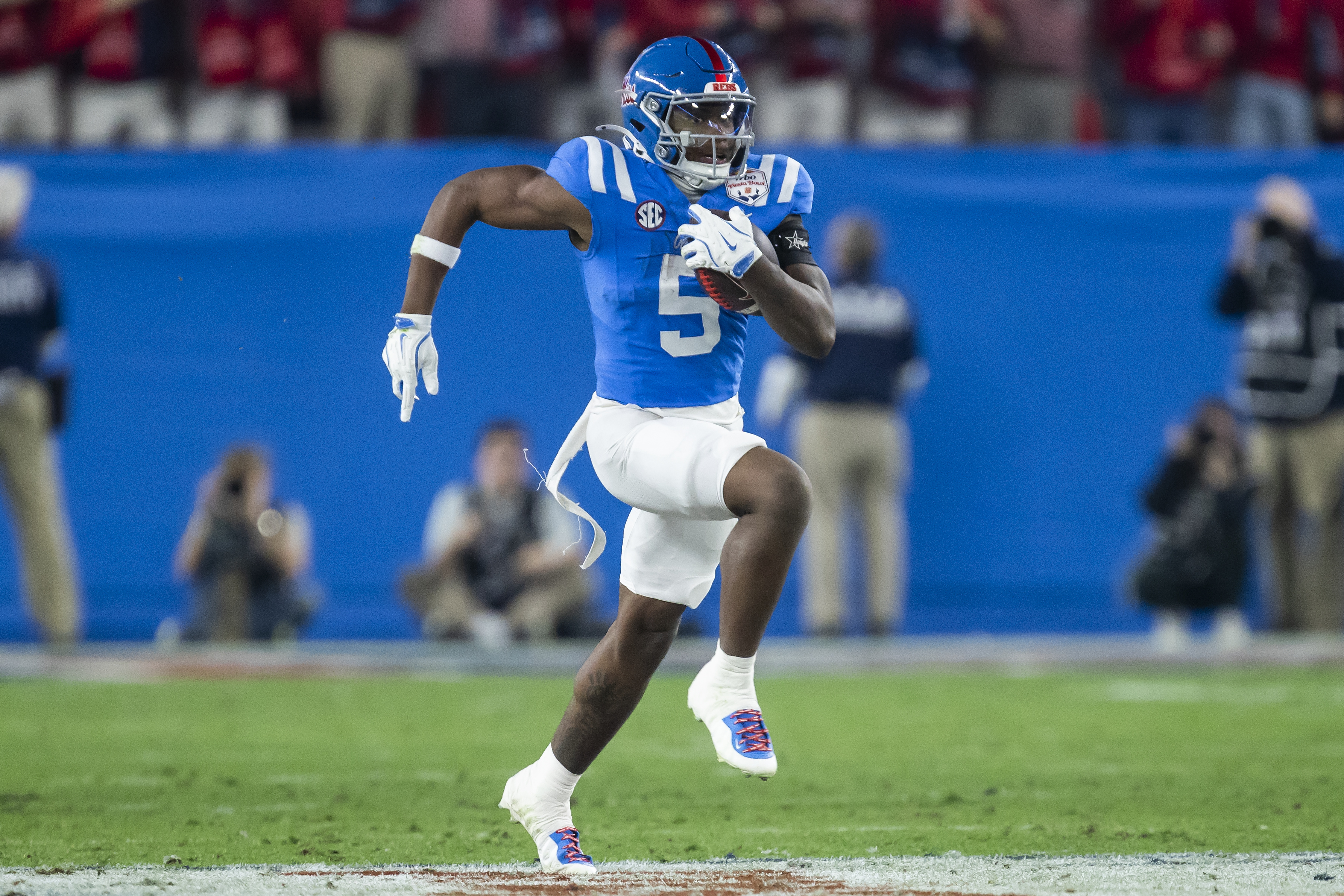
Wide receivers are the toughest position to project: In college, without question, the position with the most volatility from the preseason rankings to the final standings is the wide receiver group. Constant turnover at quarterback, coaching movement and the annual influx of offseason transfers perpetually disrupt passing-game continuity. Because of the inherent difficulty in projecting the position, the top wide receivers are extremely valuable since they provide managers with rare matchup-proof, plug-and-play options that can be built around from a roster construction standpoint. Receiver is the second-most valuable position to acquire early in 1QB CFF drafts, behind only running back. Managers should make acquiring a true WR1 a priority early in drafts since week-to-week matchup-proof startability is so rare at the position.
Quarterbacks can be waited on, until they can't: In one-quarterback leagues, and even in Superflex formats, the quarterback pool is quite plentiful compared to their NFL counterparts. From a sheer numbers perspective, there are 68 teams comprising the Power Four player pool (with Notre Dame), with just 12-24 signal callers starting on any given week. Bench spots thin out quickly, which compels managers to churn through players on bye weeks and in time shares. In the standard 1QB format, quarterback is often the first option to cut when you have to make tough roster decisions.
With a swarm of potential starters to choose from on a weekly basis, and a limited number of roster spots available to stash backups, rostering two, or at most three, quarterbacks seems to be the sweet spot from a roster construction standpoint — those numbers jump to three and four, respectively, in Superflex leagues. The heavy positional churn and ability to stream waiver wire pickups who are facing poor defenses make the high-end quarterbacks valuable and the middle-to-lower tier easily replaceable.
Addressing Tight Ends: While tight ends score far less points on average than their skill position counterparts, there are often a few elite difference makers who tilt the balance of CFF leagues come playoff time. Eli Stowers and Tyler Warren were instrumental in the success of many CFF teams over the last two years, and were worth the early round investments to acquire them due to how much higher their average weekly point total was than the positional average.
It is also important to understand the college fantasy phenomenon, which I dubbed "TEITO" (Tight End In Title Only) to address a scourge of the college fantasy realm that doesn't exist in the NFL. It's become part of the CFF lexicon and gives context to a unique aspect of the college game. Former college players like Jack Bech for TCU or current ones like Nyck Harbor of South Carolina have been listed by their programs as "tight ends" despite clearly being wide receivers in usage and stature. These fake tight ends produce respectable numbers for a wide receiver and end up being college fantasy superstars relative to the TE position group. A good example this year was JJ Buchanan for Michigan who was speculated to be a tight end, but appears at the moment to be listed as a WR currently. If his status were to change in the preseason, Buchanan's WR2 production in new OC Jason Beck's offense could be massive.
In-season strategy
With 18 roster spots and 10 starters to work with, managerial loyalty can be tested if one of your high draft picks fails to produce in the first few weeks. In NFL fantasy you're not going to simply drop a key player like Justin Jefferson after a bad start when he is having trouble connecting with J.J. McCarthy.
However, in CFF, dropping players whom you invested significant draft capital in is a common practice when coaching movement, bye weeks and role changes affect a player's productivity. While you're certainly going to give your premium draft selections more leeway, it's important to wipe the slate clean after the draft and reevaluate every roster spot on a weekly basis in case a better option emerges.

Navigating the waiver wire
The Yahoo Power Four college fantasy football player pool comprises 68 teams and features numerous unsettled camp battles that will have major roster implications once a starter is established. Unlike the 32-team NFL, which features more firmly established depth charts and long-term contracts that stifle turnover, college has to deal with substantial year-over-year movement due to graduation, early declarations, the transfer portal and a new freshman class to throw the roster into flux.
With collegiate depth charts being more theoretical than entrenched, many of these players are getting their first crack at extended game action in Week 1. Oftentimes, it doesn't take more than a few weeks to identify waiver-wire buy opportunities as the depth charts firm up. Because of that, I like to be aggressive in targeting high-value position groups where a 50/50 competition becomes 70/30, and when an assumed backup or freshman shows that he is worthy of overtaking the RB1.
While it's true that injuries will emerge throughout the season, offering ready-made pickup opportunities, more often than not, when a player takes over the top role in their offensive position group, the signs emerge early, so don't be shy about making bold waiver moves based on a player's initial draft position. The winds of change blow quickly in college fantasy, and it is best to run with the wind than against it. Be flexible and willing to let go of high draftees if they are not performing, because the college landscape is constantly shifting, whether you react to it or not. Don't get left behind.
Importance of schedule: Byes, traps
In the NFL, the style of offenses, pace of play and competence of opposing defenses are relatively even across the 32 professional franchises. Conversely, the 68 Power Four programs that comprise our CFF player pool will face FCS programs that they will beat by 50+ points in their non-conference schedule, then turn around and get throttled themselves by a blueblood powerhouse like Ohio State or Georgia the next week. The vast disparity in the quality of opponents can make a seismic difference in a team's fortunes from year-to-year, with both challenges to avoid against upper echelon opponents, and boom opportunities against weaker defensive teams that play at a rapid pace to compensate.
Bottom line, it is important not to over-commit when elite offenses like Oregon or Ole Miss play paycheck games against vulnerable G6 or FCS programs. Frequently, those games are used as "soft byes" by the Power Four juggernauts, with their starters being put on ice by halftime after a handful of touches. If your stars don't rack up yardage and touchdowns early in the game, the script can quickly turn against them once they get up 35-0 and start salting the game away with freshman running backs getting mop-up carries.
Volume is king in CFF, and many managers have been burned by over-committing resources to lopsided Power Four vs. FCS blowouts. Many times, the competitive games between evenly-matched programs that are trading scores and pressing until the very end far outpace the 77-10 games with half the fantasy scoring being done by third-stringers.
Note the fantasy regular season runs from Week 1-11 with the playoffs (default is four teams in the postseason) running Weeks 12 and 13.